
Listen To This Article!
In northern environments, using an indoor growing space (or grow room) is practically an essential aspect of raising a garden from seed.
The indoor growing space functionally allows the northern gardener to practice season extension. It’s always great weather indoors!

Whether you’re after simply raising garden seedlings or full cycle plant growth, an indoor grow room can be a functional space for growing plants.
This article will focus on the considerations and various aspects of designing and building an indoor grow room.
Determine The Grow Room’s Purpose
One of the first things you should consider is what you want your indoor grow room to be capable of.
This desired goals of your indoor grow room will determine all sorts of things, from the lights you should use to it’s overall size.
Some of the things you should consider are:
- Are you just wanting to raise small garden starts and seedlings? Or, do you want to practice full cycle plant growth so you can grow all year round?
- If you want to achieve full cycle growth, what types of plants will you grow? Lettuce is short and compact, whereas tomatoes need significant vertical space.
- How much do you want to grow? Whether it’s seedlings or full cycle plant growth, a considerable amount of space could be involved.
- What kind of space do you have to work with? Grow rooms can be everything from a small countertop to a spare bedroom.
- Will the indoor growing space be temporary in nature (e.g. seasonal to raise garden starts) or do you want a full time fixture for growing plants?
Defining your overarching goal is an important first step to building a grow room that will suit your needs.
Indoor Grow Room Location Considerations
Indoor grow rooms do have some practical and technical considerations that need to be thought through.
Not every location will be suitable for building an indoor growing space.

Whether it’s evacuating heat from powerful grow lights or simply having a place to plug those lights in, let’s talk about space considerations!
- The location needs relatively stable temperatures. In northern environments, this means a location that won’t get particularly cold or outright freeze.
- The location should be accessible, which will encourage you to visit frequently to care for your plants.
- You’ll need adequate power access for lights, fans and any other electrical needs. You may need to employ extension cords.
- Ventilation may be a factor. Small, enclosed spaces will heat up very quickly and can become dangerously hot for plants. Can you ventilate heat outdoors or to another room?
- You’ll frequently need access to water. What does getting water to the location look like?
The grow space could be in your home, a heated garage or even a heated outbuilding.
Grow rooms can be either more permanent or temporary in nature. So, while the environment does matter to a certain degree, you have a lot of flexibility for space selection.
Indoor Lighting For The Grow Room
We do have a more extensive article on artificial lighting for the purposes of growing, but we’ll quickly re-cap the basics here.
Plants need light to perform the photosynthesis process and they can absolutely do this with several kinds of artificial light.

There are specific plant focused considerations and details, but the lighting you choose will be an important decision.
You have three major technology choices:
- LED lighting – Highly energy efficient, powerful light strength, produces moderate heat
- CFL (compact fluorescent) lighting: Moderately energy efficient, relatively low light strength, produces low heat
- HID (high intensity discharge) lighting: Moderately energy efficient, powerful light strength, produces high heat
While you can get away with less powerful lighting for growing small garden seedlings, you will need much more powerful lighting if you want to practice full cycle plant growth.
We’d generally recommend focusing on horticultural grade lighting for the indoor growing space. While you certainly can use other types of lighting in the indoor grow space, purpose built lighting will heavily shorten your learning curve.

We generally recommend LED based lighting these days. Power utilization should not be underestimated and LED costs are comparable to most other types of lighting. The benefits of LED are very real.
Ventilation Considerations For The Indoor Grow Room
Air circulation is a very important consideration when it comes to the indoor grow room. Typically, this role is fulfilled by fans.
Your lights are going to create heat, which will need to be evacuated away from the plants. In addition, good air circulation will help reduce the potential for “bad stuff” like algae or fungal growth.
There are two major considerations for the air circulation within an indoor growing space:
- Heat extraction: Your lights will create heat and you need to get it away from your plants. More lights and higher wattages will create more heat.
- Internal air circulation: Your plants will benefit from having regular air circulation, essentially simulating outdoor wind. This reduces disease potential and also can work to strengthen the plant’s stalks.
Your need to extract heat from the grow space can vary based on a few factors. For example, the size of your grow room, the power of your lighting and your ambient air temperatures.
The plan for heat extraction could be as simple as growing in a large room, which will naturally heat up less quickly. The northern home often benefits from a bit of extra heat!
You might also need to purposefully vent the hot air outdoors or into another area, if heat generation is high enough.
If you need to ventilate outdoors, a squirrel cage fan is an ideal choice. This is a type of fan that can be connected to ducting, allowing directed movement of air. These come in multiple sizes, with 6 and 8 inch varieties being the most practical to work with for indoor growing spaces.

For internal air circulation, we really just need some basic fans. They can be small personal fans, larger fans or even special articulating or rotating fans.
In general, air circulation needs to occur regularly. It’s perfectly fine to consider running fans while the lights are on, but not when they are off. You could also use an intermittent schedule by turning your fans on and off.
The point is to regularly recirculate the air around your plants!
Temperature & Humidity Control
Beyond just basic air circulation, it’s often desirable to maintain temperature and/or humidity levels.
We discussed ventilation above, but it’s unlikely that you want to perform heat extraction 24 hours a day. This could bring temperatures too low and is likely just undesirable for noise and power usage reasons.

If you need to practice heat extraction, connecting your fans to a temperature controller is optimal. We like the Inkbird temperature controllers.
This will allow you to turn the extraction fan on and off based on a given temperature, allowing the maintenance of a specific temperature range.
Ideal indoor grow room temperatures are between 60 and 80 degrees Fahrenheit.
When it comes to humidity, this can be a lot more challenging. However, for the most part, plants are quite tolerant of a wide range of humidity.
Small seedlings are vulnerable to low humidity, since they don’t yet have established roots allowing significant water uptake. We find the use of humidity domes to be optimal for this use case.

However, larger plants are simply more tolerant of humidity range. You can get into humidity control, but it tends to by much more expensive.
Both humidifiers and dehumidifiers can be used to control humidity levels in a given space, along the use of a humidity controller.
If your climate is generally humid, a dehumidifier is likely the right choice. If your climate is generally dry, a humidifier is likely needed. You can also use both to maintain a specific humidity range.
In our opinion, pursuing humidity control isn’t strictly necessary for the indoor growing space. However, if you’re trying to fully optimize plant growth indoors, you may want to pursue it.
Indoor Grow Room Automation
We alluded to temperature and humidity control above. There are other things that are strongly desirable to automate as well.
Typically, you want to control your indoor grow lighting. Just like how the sun rises and sets, you can simulate this indoors as well.

You have a several options for this type of lighting control:
- Human power: Simply turn the light on and off yourself
- Basic on-off timers: Typically low cost, but provide less control
- Enhanced on-off timers: Slightly higher cost, but allow things like setting the time of day and specific on-off schedules
- Smart plugs: Moderate cost, many brands of smart plugs allow the setting of basic on-off schedules
- Full home automation: High cost. Home automations like Home Assistant allow very enhanced abilities, typically harnessing smart plugs with external controls and schedules.
Most plants will desire somewhere between 8 and 14 hours of light in a given day. Since lighting uses electricity, turning them off will directly save you cash!
As we mentioned above, you may also want to tie in your air circulation to this automation. For example, you may also want a timer that turns your air circulation fans on and off every 10 to 15 minutes.
You might also want to layer in some level of environment monitoring capabilities. For example, monitoring temperature, humidity, power usage and so on.

There are many ways to add in environmental visibility to the indoor growing space, from a simple purpose built temperature/humidity monitoring device to full blown home automation that puts the information into a database.
Vertical Space Integration In The Indoor Grow Space
It’s important to think about the concept of volume when it comes to an indoor grow room.
Vertical space often has a very low cost, whereas square footage has a much higher cost. You can vastly increase usable space by using the vertical plane!
If you’re growing small (height-wise) plants, such as lettuce or garden seedlings, you can heavily benefit from leveraging vertical space.

The most common technique for this with small plants is to use shelving. Typically, lighting is installed above each shelf, allowing you to you have multiple growing levels.
However, this increased growing space comes at a cost!
Those shelves will make it more difficult and labor intensive to care for your plants, such as watering/fertilization. They also reduce visibility of your plants, hindering your ability to catch problems quickly.
As we’ve evolved our indoor grow rooms, we’ve generally much preferred using a single plane as opposed to shelving. Those tradeoffs are significant!

When it comes to full cycle plant growth, you may need significant vertical space! Plants such as tomatoes, cucumbers and quite a few others will need vertical space to grow into.
Vertical growing can also have a serious impact to your lighting choices. The short story is that light strength quickly degrades the further from the light source it gets. You may need rather strong indoor lighting to overcome large amounts of vertical space.
Overall, you will appreciate giving yourself some room when it comes to vertical space. It can be consumed quickly in the indoor grow room, whether it’s light hangers, ventilation or actual plant growing space.
Purpose Built Indoor Grow Tents
One of the advents of modern day is the indoor grow tent. These are basically fabric tents that provide physical structure and containment, usually offering the indoor grower a dedicated indoor growing space.

If you’re looking to build a more permanent growing space, they are well worth considering and are not terribly expensive.
The indoor grow tent has several benefits for the indoor grower:
- Contains the light, preventing spillover into adjacent areas
- Walls are usually reflective, increasing available light to your plants
- Allows for fairly easy ventilation, with most tents providing convenient holes for ventilation ducting or fans
- Separates the temperature control from the room itself to a smaller space, typically easier to control
- Is much more tidy and provides for a more organized growing space
Indoor grow tents come in many shapes and sizes. They can be small (e.g. 2 foot by 2 foot) or even quite large, taking up much of a room’s area.
Grow tents are a good option for growers that might want to do year round growing. Or, if you’re a serious enthusiast and you just want one.
But, if you are a more seasonal grower (such as growing garden starts), you may want to consider more transient setups. Putting up and taking down a grow tent is a somewhat labor intensive task.
Temporary Indoor Grow Rooms
A lot of indoor growers will simply need a temporary growing space.
This is common if you simply want to raise your own garden starts from seed, or perhaps grow through the north’s deep winter.
The antithesis of the grow tent mentioned above is a more transient type of setup.
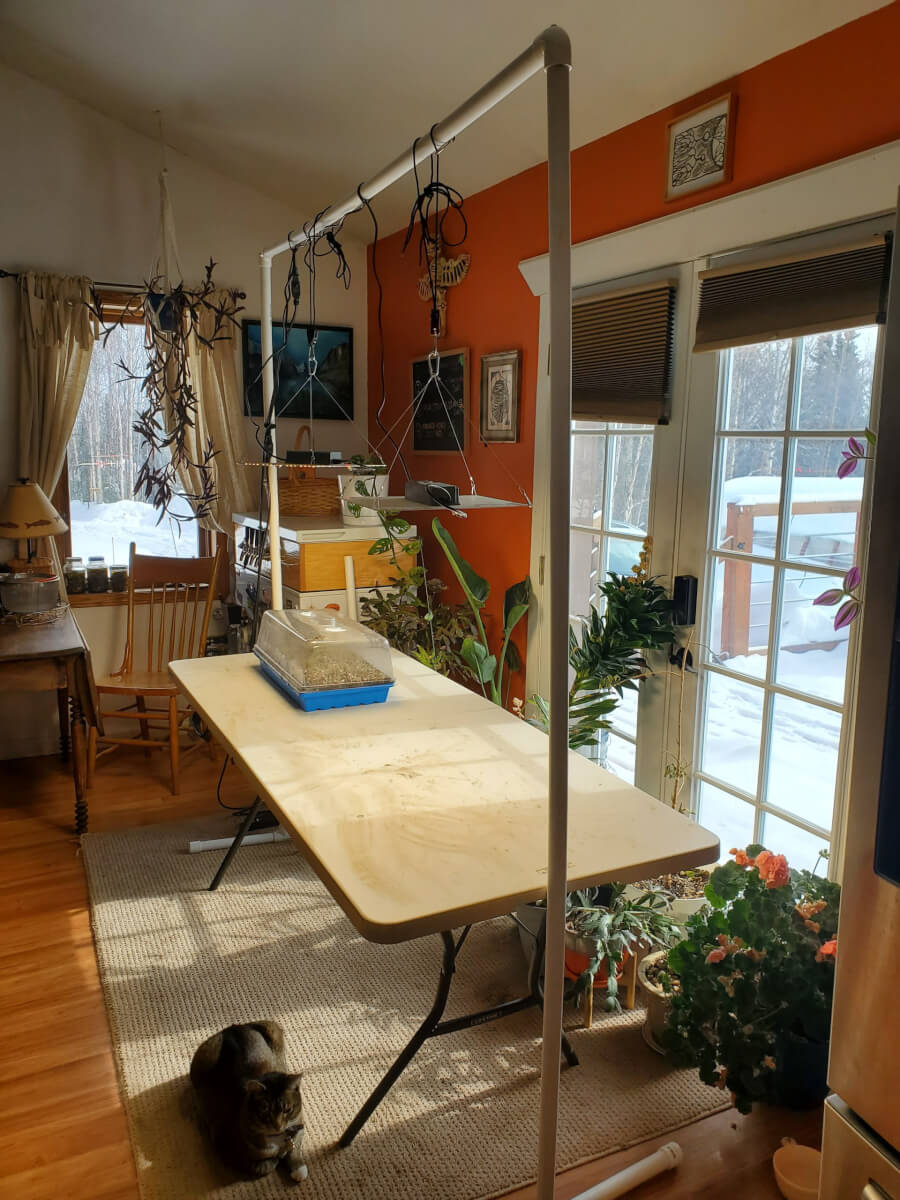
This could be anything from a simple temporary table to taking over a small section of a given room in your home.
Helpful tools to use for the temporary growing space include:
- Tables, shelving or cabinetry for putting your plants on, which makes them easier to access
- Light hangers to get lighting up in the air. This can be purpose built or even fabricated from inexpensive PVC
- Extension cords or surge protectors for getting power to your temporary growing space
We utilize a couple of temporary setups for raising our indoor garden starts. They are extremely helpful and versatile, allowing for quick expansion of our growing space when we need it.
Lastly, A Word About Safety
We’d be remiss to not discuss basic safety when it comes to the indoor grow room.
The indoor growing space often combines heat, water, electricity and high rates of power consumption. To ensure your grow room is safe, there’s a few things you should generally consider regarding safety.
- When using extension cords, make sure they are rated for the amount of power your growing space will use. Lights and fans can use decent amounts of electricity.
- If using surge protectors or power strips, these also need to be verified they are up to the task of delivering the needed power
- Do not overload power circuits. If you’re using a lot of power, you may need to use multiple power circuits. Maximum safe loads are 1,800 watts on a 15 amp circuit or 2,400 watts on a 20 amp circuit.
- Do your best to not combine water and electricity. They do not mix.
- Make sure your lighting is not near combustible materials
- While fire is highly unlikely in a properly designed indoor grow room, make sure your smoke detectors are working and consider having a fire extinguisher nearby.
Indoor grow rooms are incredibly safe when built properly. Most of the above is common sense, but we need to call it out just in case our potential reader lacks some of that.
Go Forth & Grow Indoors
For the sake of brevity, we did skip some considerations around indoor growing spaces.
For example, you could certainly pursue concepts like automated watering, pH control, hydroponic systems and all sorts of options.

But, hopefully the above offered you the basic things you need to be thinking about and various ways you can approach building an indoor growing space.
Indoor growing spaces are remarkably rewarding and are often a great tool for the northern gardener to have in their repertoire.
Whether you simply want to raise your garden starts or get into year round gardening, the indoor grow room is invaluable to the northern grower!
Thanks for reading and as always, if you have any questions or comments you can slap those down below!
That’s All We Wrote!

Having a good time? Learn something? We have an ever growing list of insightful and helpful subarctic & cold climate gardening articles, just like this one!
- Cold Climate Gardening Basics 👉
- Growing Your Garden From Seed Indoors 👉
- Advanced Cold Climate Gardening Techniques 👉
- Plant Specific Cold Climate Growing Guides 👉
- Subarctic Perennial Food Forests & Foraging 👉
- Indoor Garden Lighting & Grow Rooms 👉
- Greenhouses & Temperature Control 👉
- Harvesting & Food Preservation 👉
- Solving Cold Climate Garden Problems 👉
- 700+ 1 Minute Reads 👉
- 180+ Gardening Topics! 👉
FrostyGarden.com is 100% ad-free, junk free and we do not use affiliate links or sponsorships! This resource is voluntarily supported by our readers. (Like YOU!) If we provided you value, would you consider supporting our mission?