
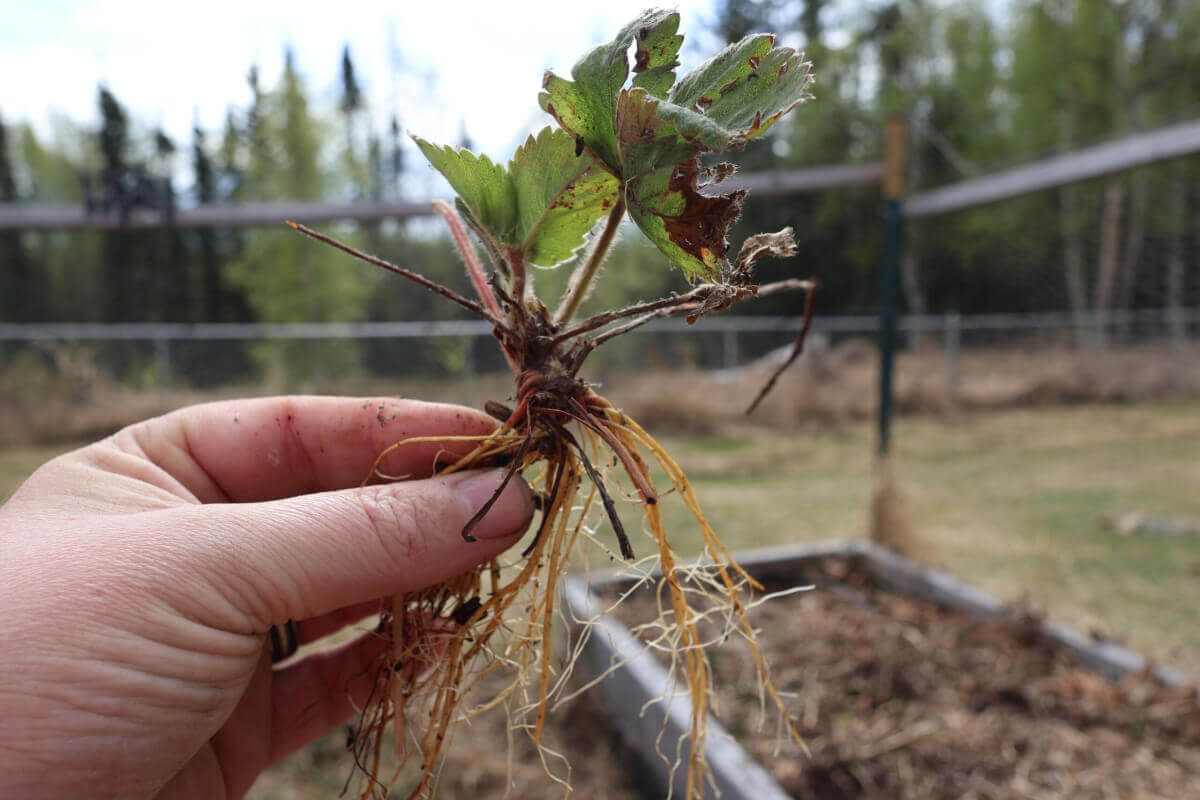
I don’t think we’ve ever talked about strawberry plant propagation in our previous posts. So, let’s change that!
Strawberries are a rhizome, which means that they grow horizontally and replicate via their root systems. Unlike a lot of plants, strawberries will spread out from season to season, rarely respecting any boundaries you set for them. Even if you contain them in a raised bed, it’s likely you’ll eventually find them growing in your pathways and everywhere else. With strawberries, this expansion is done via what are called “runners,” or small shoots that eventually throw down roots nearby. This is considered invasive behavior, but people love strawberries and thus the behavior is well tolerated among growers.
When you have an established strawberry patch, we can use this behavior to our advantage. In the early spring, the previous season’s runners will start to green up. You can uproot these newly established plants, simply by digging them up. If the runner is still attached, you can safely sever it as the strawberry has all ready rooted and thus can sustain itself on its own. This process should give you a nice, small strawberry plant that you can establish elsewhere.
From here, you have a couple of choices. You can fill in your desired strawberry beds, or expand your current strawberry growing area. This is always our first priority, as in the subarctic, not every plant will survive the winter season. Alternatively, you can put those nicely rooted plants into pots or inserts along with some soil. This allows them to be mobile, meaning you could trade, gift or sell them to others. You’ll care for these potted strawberries similar to any other plant you’d be growing in pots or inserts.
To plant your strawberries, simply dig a 3 to 6 inch hole with trowel, stuff the plant in and back fill with the excavated soil. Strawberries are surprisingly resilient, so this somewhat violent transplant process doesn’t really bother them that much. As long as their final destination is well watered, they should take to their new environment relatively well.
We’ve found it highly beneficial to mulch with woodchips in and around our strawberry garden. This makes it a lot easier to pull up those freshly rooted plants and the wood chips will just fall right out of the root systems. When they root into actual soil, it can be a bit more difficult to uproot the plants without damaging the roots.
While you can technically grow strawberries from seed, it’s a lot more challenging than your average garden plant. It requires stripping the desired variety of strawberry’s skin, drying it out, collecting the tiny seeds and also a 2-4 week cold stratification process to prepare the seeds for germination. Plus you have to start them 12 weeks to last frost! So, you’re looking at about a 20 week process in total, or 16 weeks if you buy strawberry seeds! After all that work, you might have a tendency to see weird genetic anomalies since they’ll often be F2 genetics. Most growers don’t even bother since propagating the plants is much, much easier.
With a relatively small strawberry garden, you can get a rather large number of propagations every season. We have a relatively small bed and can produce dozens of new strawberry plants every season. So, if you’re looking to establish a new bed, don’t go into it thinking you have to buy every strawberry plant you’ll ever want. You will get more than you know what to do with, eventually!
We’re super excited about our fresh strawberries this season! We haven’t yet figured out what we’ll do with ours this year, but we’ll certainly let you know once that time comes! We also have more to say about these lovely berries, we’ll get there in due time!
