
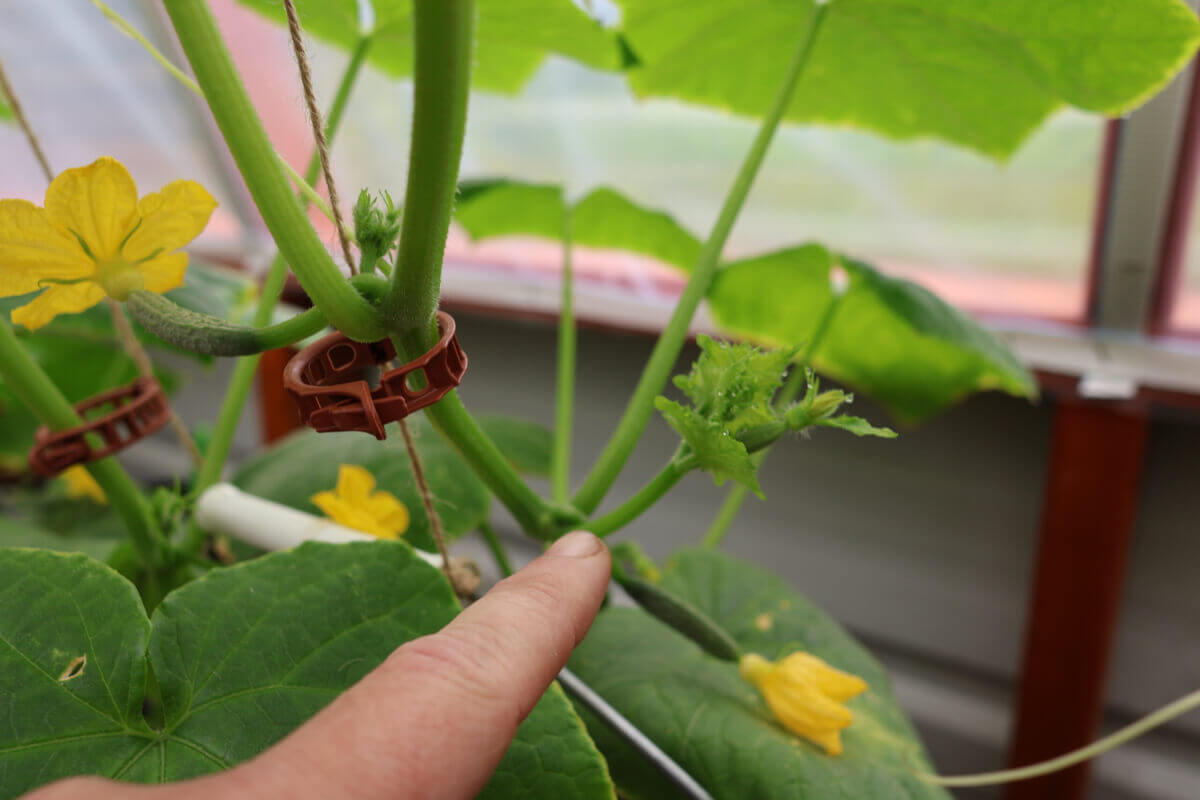
We should probably breach the topic of vining cucumber pruning. It’s a lesser known topic that many gardeners might not be familiar with, so it’s probably good to shed some light.
In a lot of ways, vining cucumbers have similar growing characteristics to indeterminate tomatoes. Despite being entirely unrelated genetically, both will have a main branch and will eventually produce secondary main branches. Like with indeterminate tomatoes, if these secondary branches are left unchecked, pretty soon you’ll have a wild cucumber growing every which way.
Most gardeners desire a singular growing stalk for their cucumbers as it makes trellising, managing and harvesting your cukes a fair bit easier. These stalks are commonly trellised upwards, training the plant to grow up things like twine, cattle panels, fencing or other trellising materials. So, this means we need to prune those secondary branches to achieve that “main stalk” concept.
With cucumbers, those secondary branches are a lot less distinctive (especially early on) than they are with indeterminate tomato suckers. They don’t produce as regularly or in such a consistent matter as suckers do on indeterminate tomatoes.
What you’re looking for are lateral branches coming off the main stem that produce both flowers/cucumbers and leaves on the same stem. In an ideal world, you’ll catch and snip these as soon as you can. We know the process of snipping plants can be a bit nerve wracking, so if you need to let things grow out to be certain, feel free to do so. You want to avoid snipping healthy leaves and definitely any cucumber flowers or fruit that are part of the main stem.
Pruning cucumbers can be helpful just for general plant health. Cukes are prone to a metric ton of diseases, molds and a litany of other issues. This pruning process promotes better airflow, which in turn reduces disease risk. In this same vein, as cucumber leaves and unpollinated cucumbers shrivel and die off, it’s important to remove them from the plant. This again helps promote good airflow and reduces the chance of diseases and mold affecting your plants.
Some growers may desire that “wild, growing every which-way” characteristic. This can be helpful in some applications, but your general trellising approach and planting densities should be designed to support such growth. Just remember, too much of that foliage can work against airflow needs, which is the number one contributor to mold growth and disease propagation.
Some of you may be growing bush cucumbers. These are more akin to determinate tomatoes, so there’s a lot less pruning care you have to perform with them. Just like with vining varieties, you do want to remove decaying leaves and fruit from the plant as soon as you can. Overall, bush cucumbers are pretty much on autopilot through the season.
If you have the unfortunate event where one (or more) of your cucumbers succumb to disease or other issues, it’s important to remove the plant as soon as you can. A lot of cucumber diseases spread through proximity, so getting that foliage away from your still-healthy plants is always a good idea.
We will definitely have more to say about cucumbers (and other pruning things we do) soon. For those of you growing cucumbers in a greenhouse, your plants are likely starting to take off! We’ll certainly be discussing other important things about cucumbers in the short term!
