
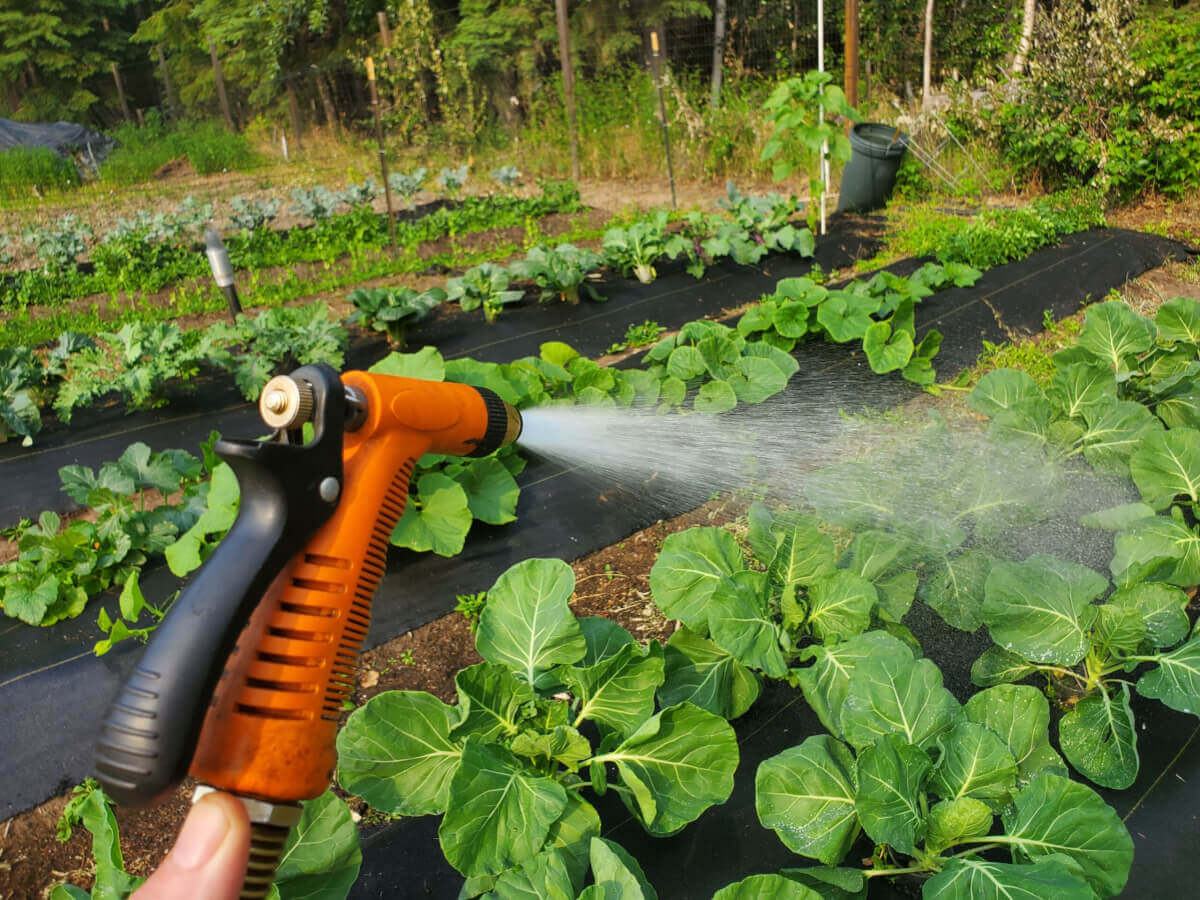
This post might make us some frenemies, let’s see! We’re going to talk about water temperature and whether or not it has a meaningful impact on your plants.
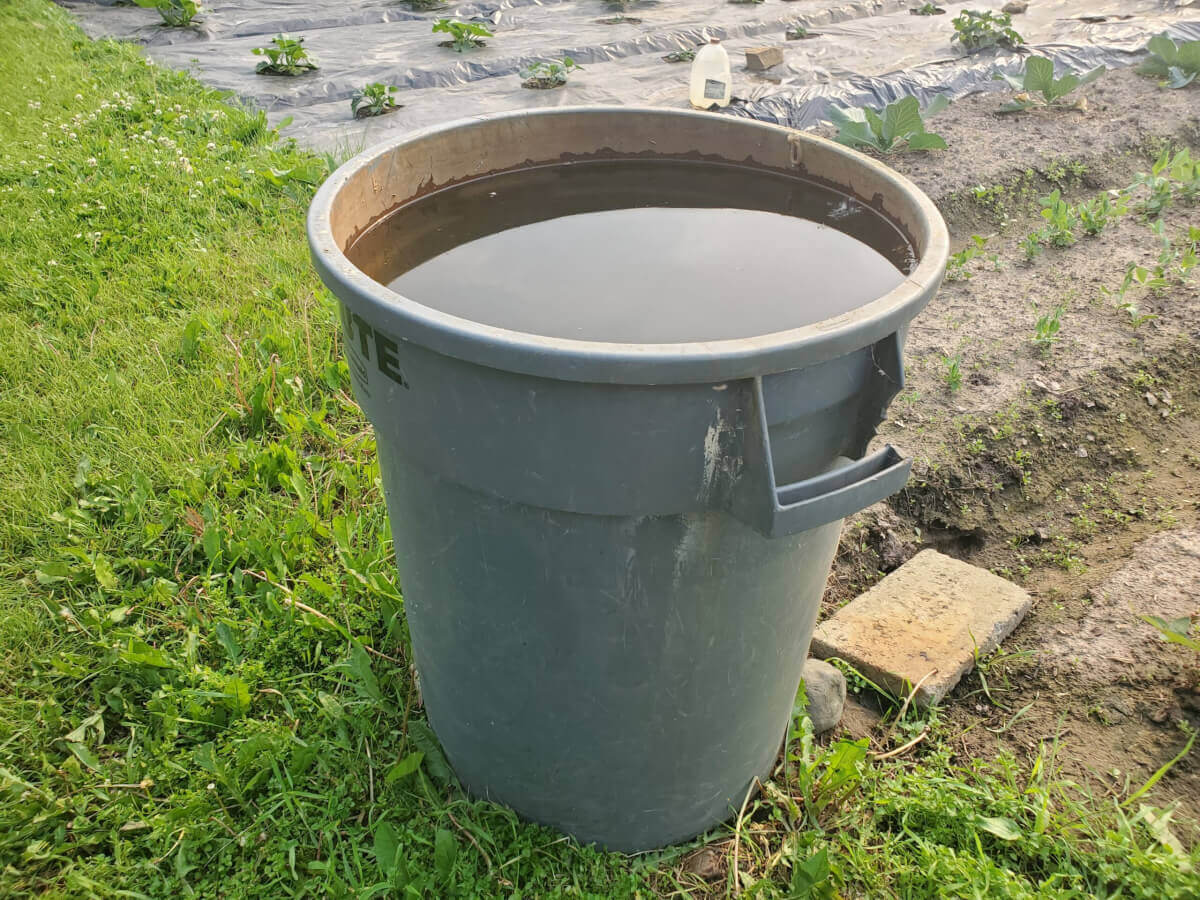
There are many northern gardeners, certainly some among you, that religiously warm up their water before giving it to their plants. The common technique is to fill a garbage can with water and then dip a watering can into it. Alaskan and other northern tap water is often quite cool, typically in the 40’s Fahrenheit. So, this practice warms up the water, easily by 20 to 40 degrees!
We are aware of academic studies that describe, down to the cellular level, the biological impact of cold water on plants. These studies directly compare “warm water” and measure the biologic impact for the amount of time it occurs and what parts of the plant are primarily affected. There’s no arguing that there is an actual physiological impact and we’d guess those studies are likely the original source of the water warming practice.
The right question, if you’re a gardener and not a scientist, is whether there’s a meaningful impact on measurable metrics that matter to the gardener. We’re not aware of any quality studies that looks at things like plant size/weight, plant maturity, plant survival, plant quality or anything that impacts what a gardener actually cares about!
We practice things both ways. Some of our gardening leverages pretty cold tap water. Some of our practices naturally warms up the water. But, for the latter, the water warming effect isn’t necessarily why we do it! After years of experience doing things both ways, we’d argue there’s not much of a meaningful impact of water temperature. At least to things we actually care about. If anything, we’d argue that our “cold water” plants tend to look healthier and more robust!
It’d take a fairly extensive study to measure impact on those things we’d care about. All the variables would have to be controlled, essentially providing for identical growing conditions in both cohorts. The differences would have to be measured across many hundreds (and possibly thousands) of plants in each cohort to correct for genetic instability and other uncontrollable variables. We’d even estimate the study might be highly variable based on the studied plant variety! That’s probably why it hasn’t been done, it’d take a lot of work!
If you look at thermal dynamics “in the real world,” any cold water that you’re applying to your soils is going to find an equilibrium fairly quickly. The warmer soils are going to increase the temperatures of the water, and the water is going to briefly drop the temperatures of the soil. Warm and cool are effectively “attracted” to one another. If you have 70F soil and 40F water, that equilibrium will be somewhere in the middle of those two temperatures and not at the extremities. At that point, you could argue that our cooler night time temperatures have a greater impact due to their length and frequency at which they occur.
This kind of thing is something we fairly regularly run into as we critically think about various gardening practices. Sure, there might be information out there that supposedly supports a practice. And some people follow it, sometimes religiously, believing it has some meaningful impact to their gardening practice. Perhaps, though, it doesn’t make as much of a difference as we think? Few are willing to counter their assumptions, especially when the “other side” is assumed to provide a negative result.
It’s an interesting question. What say you, fellow northern growers?

So I’m doing an experiment, on what water temp help a plant grow better, any thoughts??
If there’s one thing I’ve learned through many “non-scientific” studies is to make sure you have enough plants in your different groups to reasonably prove “statistical likelihood.” Basic genetic differences from plant to plant can radically alter the size, quality and harvest of a given plant, assuming the same treatment. With small plant counts (e.g. 1-2), it’s very easy to see these differences, yet they have zero bearing to your test. We usually work with 4+ plants in each different group and often, that’s not even enough to prove statistical likelihood. “Real” studies typically perform averages across dozens, hundreds or thousands of plants.