
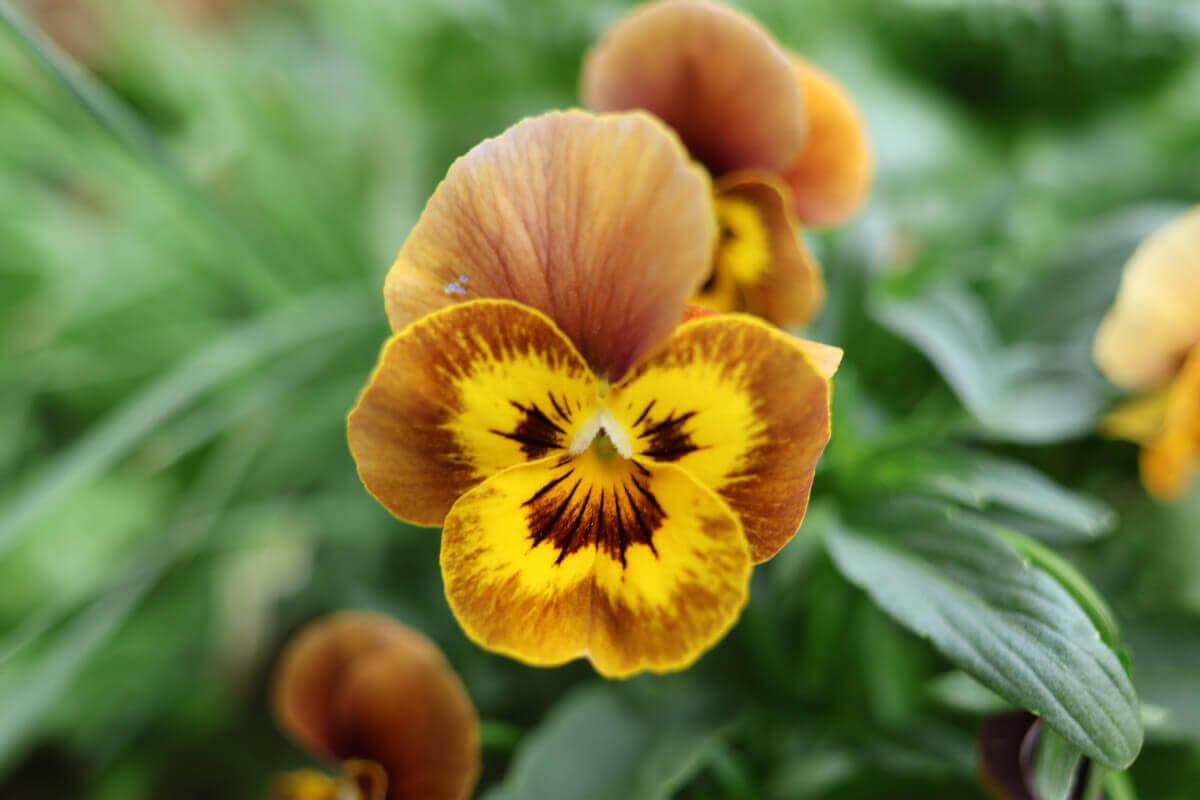
Happy Friday, everyone! Hard to believe we’re closing out the first month of growing! Summer is sure moving way too fast, but we’re excited to see so much progress with our gardens.
Today’s Flower Friday is going to be about violas! I know we probably say a lot of flowers are our favorites, but with violas, we actually mean it! This sweet, early blooming annual wins us over every year, offering us a spectacular variety and heavily laden displays of beauty in our deck planters and beyond.
Violas are the largest genus in the violaceae family, which is comprised of over 680 unique species. While most are grown as garden focused annuals, there’s a few perennial species that survive in warmer climates. If you’re wondering what separates violas from the pansy, it’s the small nature of the flower. Most pansy flowers are, in fact, actually a cross of some form of viola.
An interesting fact about violas is that the overwhelming majority of them feature bilateral symmetry, meaning each side of the flower mirrors the other. This can lend itself to face-like appearance in some varieties, which can really be a head-turner as there are very few flowers that feature this trait.
Some violas will produce a compound called ionone, which has a phytochemical effect of desensitizing the receptors in the nose. Viola are actually quite fragrant, but many report violas as having “little or no scent.” It’s actually that first smell that prevents further detection of aroma from the flowers! It isn’t currently known what biological advantage this provides the flower, but it’s a super interesting human-flower interaction. This trait is exploited in the perfume industry, creating a fleeting aroma that can only be enjoyed in small, intermittent doses.
If you’ve grown viola, you’ve probably observed its tendency to create (non-invasive) volunteer plants, often times quite a distance from where viola were previously grown. Many viola species disperse seed through a process called explosive dehiscence, which can distribute seed as far away as 15 feet! Furthermore, ants will often times disperse the seeds even further. We love this aspect of the viola and our property often has several dozen species of volunteer viola popping up all over the place!
Medicinally speaking, viola produce fourteen different anthocyanins, which are a known, strong antioxidant. This has been shown to provide in-vitro anti-microbial and insecticidal activity. Viola has also been used in clinical studies, showing it can act as a beta-antagonist that aids cough suppression in children with asthma. It has also been used to treat dermatitis in a topical herbal formulation. Viola were even explored for anti-HIV properties during the peak of the HIV epidemic, showing some promise in those studies.
Viola are exceptionally important to the culinary world, being used for all sorts of things like plate decoration, salad garnishing and visual distinction of a cocktail. Some species offer flavors like vanilla, wintergreen, pea and a general perfume essence. In Toulouse, France, the French have created a rare candied violet, called “violettes de Toulouse” which preserves the flower through an egg and crystallized sugar mixture. If you’ve ever had an Aviation cocktail, there’s a good chance you’ve experienced “Creme de Violette” which is a purple liqueur often created from viola.
This year, we’re doing an interesting experiment with our violas. We’re growing violas in “production status,” meaning we’re giving a particular variety every bit of care we’d offer food producing plants. Our goal is to create a liquor based infusion, inspired by the elusive Creme de Violette liqueur. This learning experiment is focused on color extraction, compared to flavor extraction that we often practice with infusions. Our end-goal is to create a proper Aviation cocktail through this process, although our version will be a decidedly different color from the traditional commercial liqueur. We’ll certainly be sharing more about this project as it develops!
We could talk about viola for ages, they are a fascinating flower with a surprising number of uses. We love growing them and continually expand our repertoire of varieties that we grow each year. They work great in containers, but also find themselves at home in beds and anywhere else small flowers work. If you don’t (yet) grow them, we hope you appreciate our passion for them and consider growing some yourself!
