
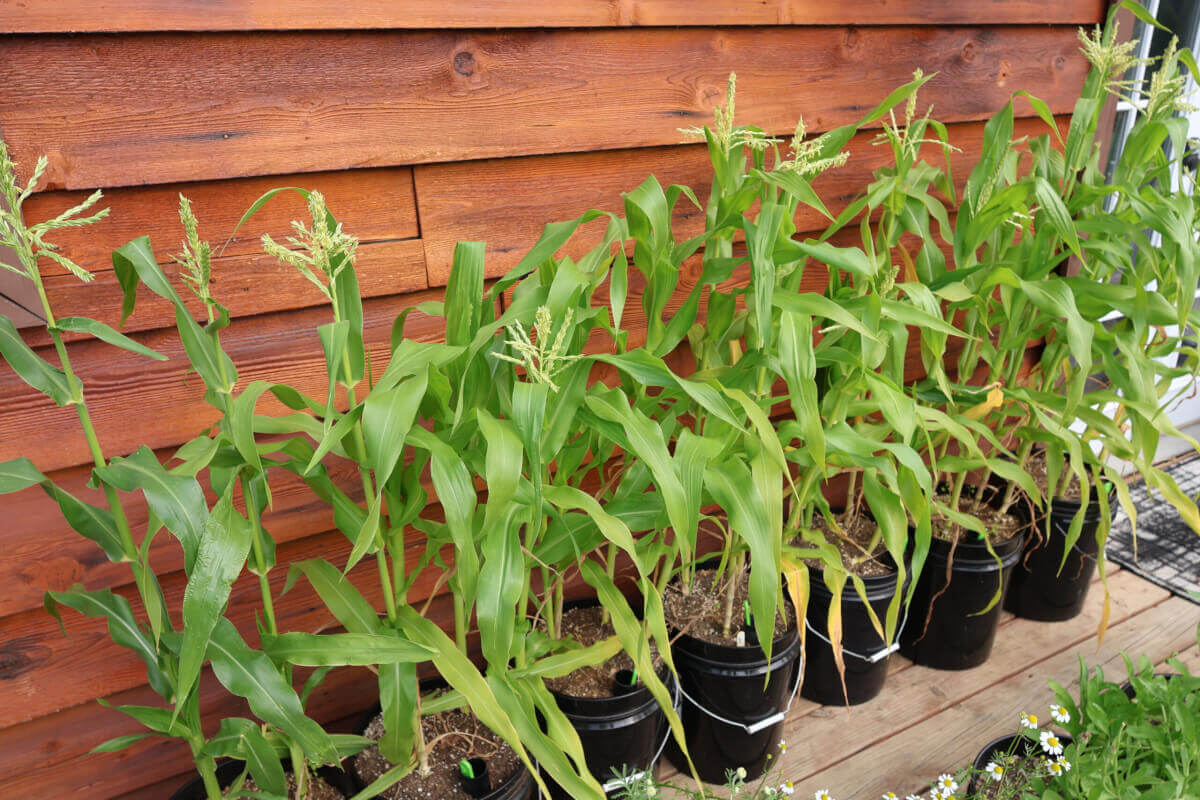
Well, it’s probably a good point for us to talk about our new corn trial this year. We’ve been interested in some of the “next-gen” yellow corn varieties that have somewhat recently become available, making yellow corn a viable crop in extreme northern gardens.
We changed things up this year and went with a new-to-us variety called “Quickstart.” It’s a 70 day, super fast growing variety and is claimed to favor cooler soils like we often see in subarctic gardens. In years past, we’ve been playing with varieties recommended by Alaska’s cooperative extension service. We’re feeling comfortable enough with trait selection to get out on our own for variety selection now, so this is our first attempt at a “self-selected” variety.
So far, this variety is definitely edging out all the varieties we’ve tried before. This is some of the earliest tassling that we’ve seen in the season and it looks like the tassels will be providing pollen quite soon. We’re still awaiting the silks, but they look like they could be coming on any day now. It’s sometimes hard to pick apart seasonal advantage in these things, since we’re also running considerably warmer this season compared to average. But, we do try each variety over 2 to 3 seasons, just to better inform that outlook.
As you can see, we grow our corn in containers and we do this mostly to promote warmer soils. Despite any “tolerance” towards cooler soils, corn is definitely going to approve of soil warming techniques. We’re still figuring out our ideal crop density for growing in containers and we’ll probably consider downshifting to three corn stalks per bucket in future seasons. Corn likes dense placement, though, and it also helps for pollination. It might not be obvious, but we’ve got a few “micro-trials” with different planting densities using 2, 3 and 4 corn per bucket.
We do opt to pollinate our corn by hand. While we get enough wind to theoretically provide for natural pollination, we’re also not growing a massive corn field where pollination is virtually guaranteed. This process is conducted by cutting off a bit of the tassel and lightly brushing the silks, once they produce. Each and every silk needs to touch pollen for all the kernels in the cob to produce a kernel.
One of the biggest struggles we’ve observed in our corn trials is early tassling, well before the silks are ready. This is a known issue with growing corn in cooler climates, it’s usually brought on by cold stress of the plant. We haven’t found any “great” workarounds for it yet, but we often do have enough pollen to provide for pollination anyway.
Our corn season got off to a rather rocky start this year. We discovered that our cat, Bridger Widger the Onion Eater, also has a strong affinity towards eating young corn. We lost about 30% of our early crop to this “pest” and had to re-sow a good portion of our total crop. At this point, this seems insignificant, but some of our crop is about a week behind the rest.
We’re also playing with placement, this year favoring a location right next to our home. This not only provides for excellent thermal mass to keep our crop warmer, but it also shields our crop from our occasional heavy winds. Last year, we had a heck of a time keeping our crop growing straight up during our thunderstorm season. This change has seemingly provided an excellent benefit and will probably be a permanent strategy we use going forward.
Corn is definitely one of those crops that are not quite as “popular” in the northern growing community, but we’re definitely seeing it grown more and more. Truly, these yellow sweet corn varieties that can actually produce in our season are somewhat new to the world. White corn has been favorable for some time, but yellow corn is a different animal. We’ve been testing them out ever since we became aware of them. And while it’s not a perfect crop for northern growing, we have been successful (to at least some degree) every season that we’ve tried.
We’re excited to see how these finish up and we’re likely going to give a follow up once our crop fully matures. But, we figured some of you might be interested in a quick mid-season update of this new trial we’re conducting!

How did Quick Start do last year. Are you doing it this year and can I get some!
It was OK, at least barely enough to attain a second year trial this year. We had an exceptionally cool summer last year, though, so we felt it was fair to give it another shot. In years past, we’ve grown the Cafe variety and it’s done fairly well. We’re trialing various varieties to try and find “the one” that’s good for our climate.