
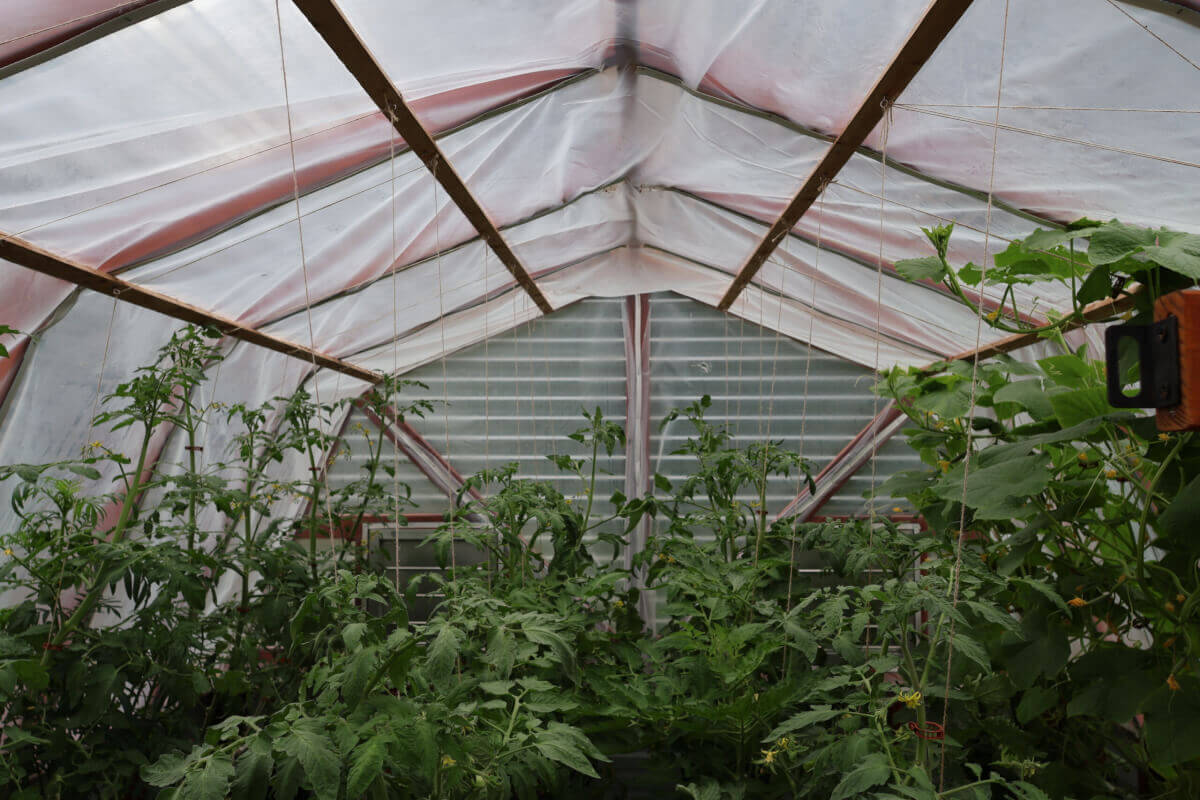
Let’s talk vertical greenhouse growing strategies! This is possibly one of the most important topics when it comes to maximizing the use and space of any greenhouse out there!
Any greenhouse that you buy or build will never be enough. No one, ever, said “Gee, I sure wish my greenhouse was smaller!” And while your greenhouse might be severely limited by square footage, what you do have going for you is volume. If you put some thought into how you’ll use your greenhouse, you can maximize that volume and get the most out of that expensive growing space!
Our general goal with our greenhouse is to take advantage of as much of the vertical space (and thus, volume) as we can. For the most part, we focus on growing plants that are going to get tall in our greenhouse. We want things to grow vertically and take up the vertical volume within the greenhouse. We heavily depend on trellising to get our plants to the tippy top of our greenhouse.
This is one of the reasons we entirely focus on indeterminate tomatoes. Indeterminates will grow tall, sometimes 10 to 12 feet, even in our relatively short three month season. We prune those suckers so the plant doesn’t grow laterally and start interfering with other nearby plants. We use 18 inch spacing for all of our greenhouse plants, which is definitely tight, but manageable if you’re entirely focusing on that vertical growth.
On either side of our greenhouse, we’re dealing with a couple of roof pitch changes given that our greenhouse is a gambrel style. We can still treat our plants the same here, but we have to train the plants to follow that pitch. This is fairly easy to do if you perform the training while the plant is growing. In our case, we train cherry tomatoes on one side and cucumbers on the other, up the wall and towards the greenhouse peak.
You might wonder about the effect of shading, given that we’re intentionally blocking the sides and roof of the greenhouse. We likely do see a bit of growth slowing from not providing “maximum” access to sunlight, but all of the plants still have access to plenty of light. We don’t block either the front or rear sides of the greenhouse, plus any shading is just going to encourage more vertical growth.
If you insist on growing shorter plants in the greenhouse, shelving is an excellent way to maximize that square footage. You definitely want each shelf to provide a bit of height, so that you allow both plant growth and access to sunlight. But, you can use shelving to double, triple and sometimes even quadruple the square footage you have in your greenhouse.
One thing we’ve done in years past is to leverage hanging baskets in our greenhouse. Instead of growing from the bottom-up, in this case we grow from the top-down. Good choices of plants for this kind of growth are tumbling tomatoes, but even vining plants like cucumbers will certainly find gravity irresistible. The main reason we don’t do this today is because we’re now using practically every cubic foot in our greenhouse by the end of the season.
We like to say that walkways are a waste of good growing space. When we designed our plant layout, we focused entirely on plant square footage and minimized walkway square footage. While you certainly need ready access to your plants, you can also shove plants into the corners and ends of the walkway to further maximize your use of space. Greenhouses are one of the most expensive growing methods, so don’t feel bad about making it work well beyond “reasonable” levels of volume.
Things are looking pretty good in our greenhouse this year. With a little bit less than two months to go, we’re primed to take up pretty much every cubic foot of our greenhouse this year. We’re slightly concerned about our cukes overtaking our rooftop, but that’s a future Frosty Garden problem. We’ll either prune the plants back or maybe we’ll just deal with it. Hope you found these insights helpful!
