
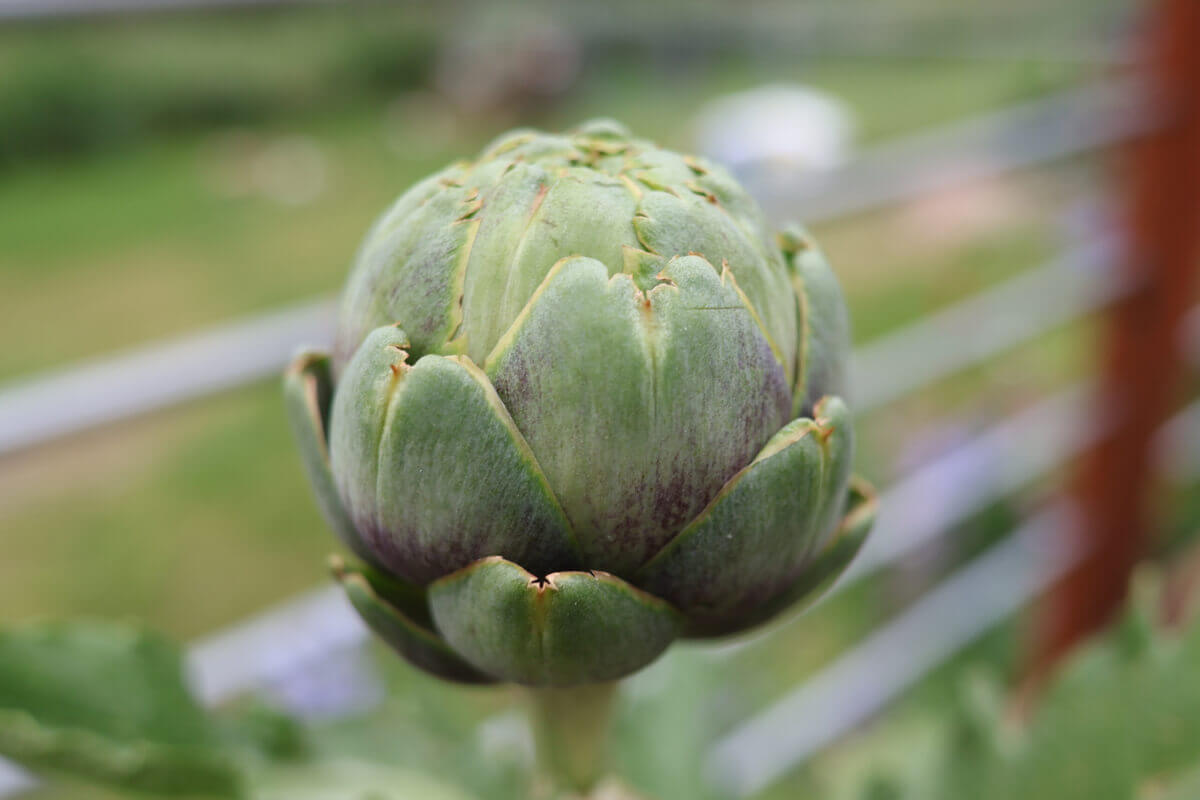
Let’s revisit artichokes and talk about what you should be seeing right now, about 3 to 4 weeks to our first frost. We love the fact that we can grow artichokes in the far north. It’s an aspect of northern growing that just can’t be replicated at every latitude.
At this point in the season, you should definitely be seeing artichoke heads develop. If they haven’t yet developed by this point, there’s little hope that you’ll get a mature choke. The artichoke heads usually take at least 45 days to fully mature. So, doing a little bit of math, we can deduce that there’s just not simply enough time left in the season.
If you’re not at this point, and assuming you used proper “annual growing” genetics, there’s two likely culprits for this. The first is you didn’t start your artichoke early enough. We recommend sowing them at 10 weeks to last frost, which is quite early in the season. The next big one is that artichoke really like “linear growth” and the ability to expand their roots. If you’ve constrained their roots at any point, especially in the early season with small pots, they often won’t produce their head in time.
That latter one was one of those “learning moments” for us where we had to “crack the code” of growing artichokes in the north. We’ve encountered lots of little nuances about growing that took diagnostic effort to figure out what was wrong. Much of the time, these kinds of things are not “spelled out” and that’s also one of the reasons we dedicate so much of our time to talking about these kinds of growing nuances.
Artichokes are decently cold hardy though and will withstand some frosts. You can certainly put them on the backburner for your harvests. They are best to leave on the plants, until you’re ready to use them, as they don’t keep well, even with refrigeration. But, don’t leave them out there too long as they definitely will perish in a hard frost.
We are getting really excited that artichoke season is coming soon! We’ve taken to growing enough for fresh, personal use. Artichoke only last a few days in refrigerator, so to us, they sort of mark a celebratory point at the end of our growing season.
Artichoke is not a veggie that we put a lot of focus into preservation. It’s one of those veggies where the space they take just isn’t quite worth the reward, at least beyond some fresh eating. To grow enough for meaningful preservation would require a lot of space. But, if you are looking at preserving your artichoke, the blanch and freeze technique is your #1 go-to method for that. You can also do things like pickling the hearts. There’s a few other preservation techniques, too, and it’s worth doing some research if that’s your goal!
