
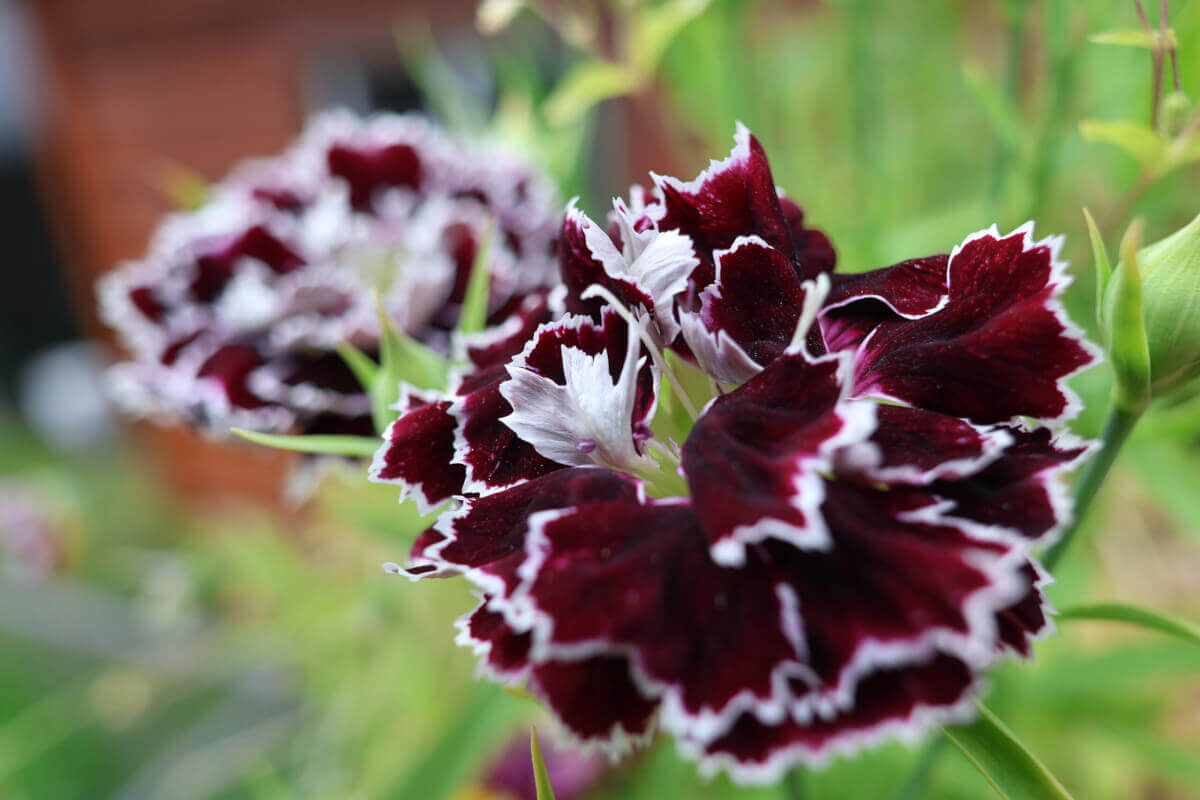
Woohoo, it’s another flower Friday here at Frosty Garden. This week, we’re going to feature a genus we’ve talked about before, but introduce you to a new species! Dianthus is our focus for today!
While you might not recognize this flower by its scientific classification, you’re likely familiar with at least one of its species. The most popular flower within the dianthus genus are Carnations. However, the dianthus family is home to nearly 340 known species, many of which are far more exciting than the traditional Carnation.
Dianthus has been known to human society for ages, with the flower being a subject of both Greek and Roman mythology. It is also one of the oldest species that have been hybridized by humans, with the first attempts at new cultivars starting back in the early 1700’s. As a result, many thousands of cultivars exist today and they are available in all sorts of shapes, colors and markings. Over 100 different varieties have the distinction of receiving the Royal Horticultural Society’s Award of Garden Merit.
There’s a really curious etymological background with dianthus, in that the color (and word) “pink” is thought by some to have originated based on dianthus flowers. If you’ve ever heard of “pinking shears,” these were named as far back as the 14th century after the frilly edges of various dianthus species. To our knowledge, it’s the only known case where the color may have been named from the flower. The Greek root of the word dianthus means “divine flower.”
While not all species of dianthus are considered edible, there is some history of using the flower in culinary applications. The petals of certain varieties have been used to make teas, syrups, colored baked goods, colorful salads and garnish for high end cocktails. The taste is often described as peppery, spicy or clove-like combined with floral and the flower’s scent often matches the flavor fairly closely.
One of the more common applications of dianthus is in the perfume business, the unique peppery scent has been useful across various cosmetics. It is also an important flower in the the cut flower trade, with many florists keeping dianthus well stocked in their inventories.
Medicinally, dianthus has been traditionally used in Chinese, Japanese and Korean medicine for thousands of years. The most common eastern medicinal applications have been for treatment of wounds and gastro-intestinal disorders. It has also been used to treat urinary tract infections.
Like with many flowers, modern pharmacology is simply catching up to long known ethnobotany uses of flowers. Several modern studies have shown certain dianthus varieties to have antiviral, antibacterial, antifungal and anticancer properties. Most notably, a phenolic compound called kaempferide triglycoside is produced by dianthus, which has shown some promising results in colon cancer treatment. Dianthus seed extract has shown antiviral activity against HIV and hepatitis. Roughly 75 species of dianthus have shown strong bioactivity, with potential uses in modern and more ayurvedic medicine applications.
We grow dianthus for the looks. There’s few flower species we grow that have such vastly different appearances among different varieties. We haven’t found a single species of dianthus that we haven’t liked a lot and they make for excellent additions in our cut flower vases. We are always game to add a new dianthus variety into the mix and it seems there’s enough out there to last us a lifetime!
