
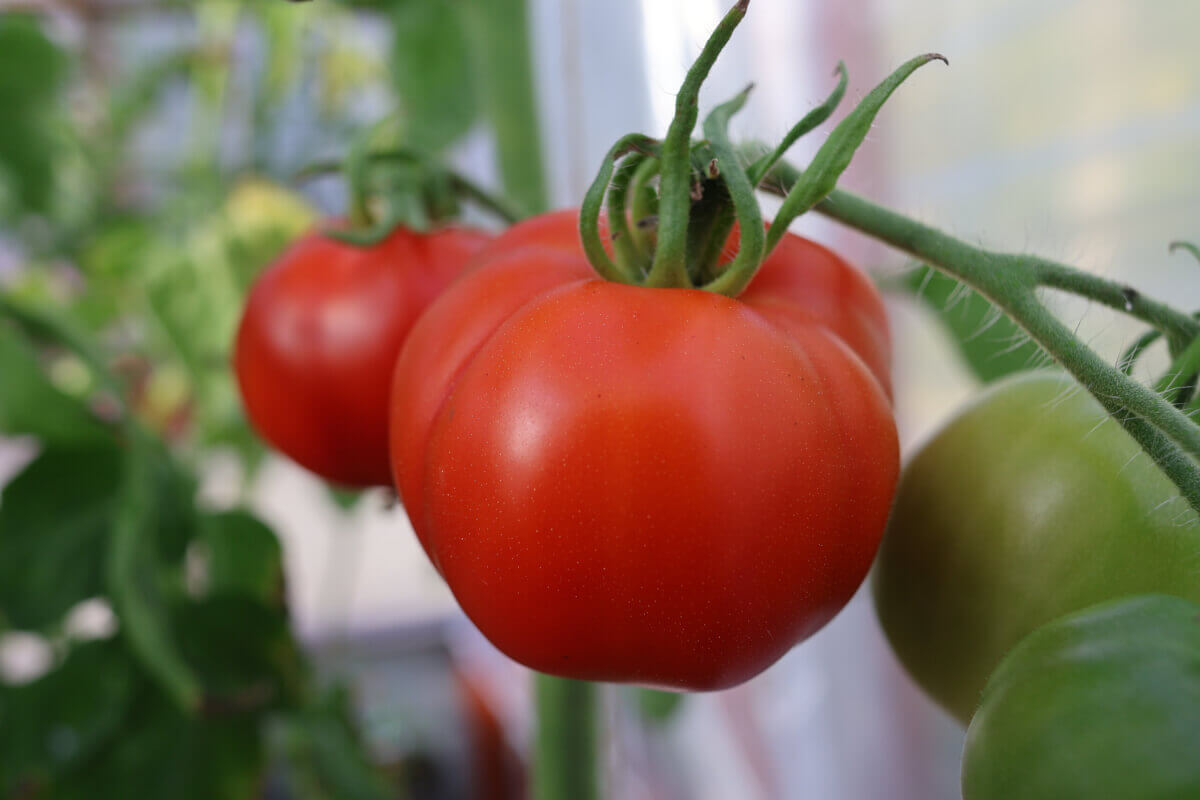
OK, so we’ve received a few direct messages on tomatoes. So, that means many of you are probably thinking about the cold climate end game with them and what you should do. We’ll try to cover both outdoor and greenhouse grown in this post!
Overall, our strategy is to keep our unripe tomatoes on the plant as long as we possibly can. How long will depend on whether you’re outdoors or in a greenhouse. Tomatoes on the vine have a chance to ripen more naturally or at least create what we’d call a “mature, green tomato.” Even if your tomatoes don’t fully mature, we can force ripen them to maturity later. But, we want to give them the “best chance” to mature that we can and that means that they receive water and nutrition.
In ideal circumstances, tomatoes mature the best in somewhat warmer temperatures. Typically above 55F and preferably in the 60’s. This is not in the cards for many of us northern outdoor tomato growers, but is possible in the greenhouse. This is honestly what makes extreme northern outdoor tomato growing so challenging. When we need the heat most, it’s just not there. At least where we are at, we’ve all ready had multiple dips into the 30’s. But, if you’re growing outdoors, hope for the best with the weather!
For harvest timing, outdoors is clearly more sensitive. Frost is most probable to develop at temperatures of 34F and below. We keep a very close eye on our shoulder season forecasts and when we see 34F, that’s usually when we “call it.” Your tomatoes will not be happy about temperatures into the 30’s, but when the plants are mature, it’s the frost that will “get them” and not the temperatures.
In the greenhouse, we have a little bit more time and flexibility, but it’s not infinite. The issue isn’t during the day, but rather overnight when the sun isn’t creating thermal energy. It’s not uncommon for greenhouses to equalize with outdoor temperatures and frost can certainly happen even in a greenhouse. Very generally speaking, the greenhouse gets you about two weeks of season extension past your first actual frost. Temperature controlled heaters can also extend it even further. But, it’s important to keep an eye on it. We often just set a harvest date, typically 2 to 3 weeks after our first frost.
If you haven’t yet cleared tomatoes that simply will not grow to size by this point, hopefully you can muster a little more courage at this point to remove them. As we barrel down on our typical first frost dates, time is running really short and we’ll soon be on borrowed time. There’s only so much you can do in a week or few! Remember, it’s easier for the plant to mature “some fruit” than to expend its energy trying to mature many fruit.
Just prior to first frost, or our desired harvest date for a greenhouse, we’ll harvest all of our tomatoes regardless of maturity. We typically separate out mature fruit from our immature fruit. You might have a lot of green tomatoes! Fortunately, we can force ripen our immature fruit!
To force ripen the fruit, you can simply lay them out on a table or flat surface. You want them to be near one another and in a single, flat row. By doing this, many of them will start to turn red or their predictable color over the following week or so. You want to maintain decent air circulation around your tomatoes during this process.
What’s going on here is that tomatoes produce ethylene, which aids in ripening. The desired concentration of ethylene is quite low, typically under one part per million. You might have heard of things like putting them in a paper bag, or even putting a banana peel inside it. However, this can easily create too much ethylene and cause a rapid escalation from ripening to rotting. A little ethylene goes a long way, so using a table or countertop is just fine! If it makes you feel better, you can lay a piece of newspaper over your tomatoes, which will maintain air circulation.
So, that’s our end game! Hopefully it makes sense! I had to re-write it three times as I really wanted to encompass outdoor and greenhouse grown in a single post. As always, if you have any questions, let us know!
