
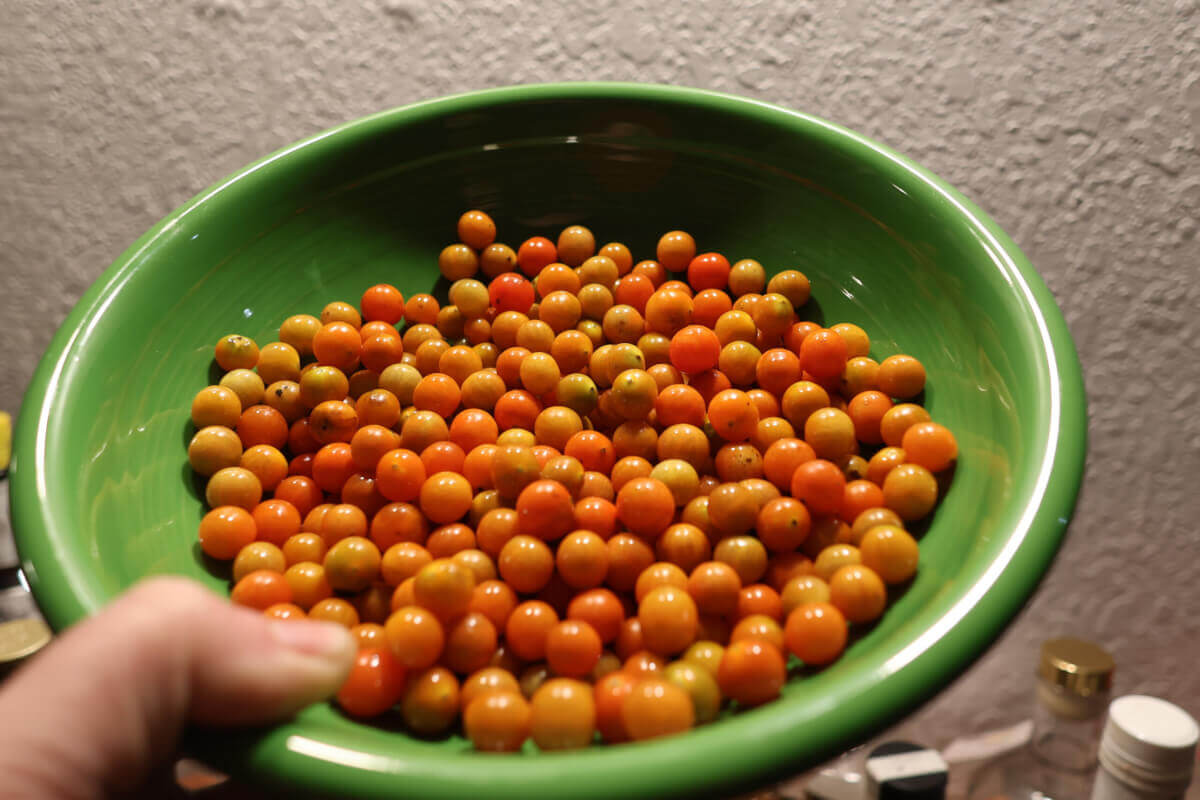
We shared this one last season, but we figured it was worth repeating. This one’s about our experimental, outdoor grown tomato crop using Spoon Tomatoes!
Now, spoon tomatoes are what could only be described as a “novelty crop” at best. We definitely don’t make a habit of growing these things. These tomatoes are quite tiny, not even as big as your fingertip. They’re called spoon tomatoes because you can fit many of them in a spoon. Put simply, they aren’t very practical and are quite labor intensive to both harvest and prepare.
Tomatoes, when grown in subarctic soils, are simply challenging. While it can be done, and can even result in full size ripe tomatoes, it’s much more challenging than growing tomatoes in a greenhouse. The cool soil temperatures and cool ambient outdoor temperatures both work against this warm loving plant!
But, we were interested in trying them as an outdoor tomato, grown directly in subarctic soils. We’ve definitely observed a correlation between tomato size and speed of ripening in cooler than average temperatures. We were able to get quite a few ripe tomatoes, pulling a couple of pounds of ripe spoon tomatoes off of three plants.
Spoon tomatoes are an indeterminate tomato type that grows very much like a bush. It tends to spread out, taking advantage of decent growing space that you give it. It prefers to grow this way and would be almost impossible to “tame” into a single vine like we grow most of our indeterminate tomatoes. We’ve found it generally compatible with our “large plant” focus we use at our community garden.
One of the reasons we do this kind of research is because we know there’s lots of northern growers out there that don’t have the benefit of a greenhouse. We obviously advocate for solutions like using containers to warm subarctic soils, but even this isn’t a perfect solution. If our choice was between “no tomatoes” and “outdoor spoon tomatoes,” we’d definitely choose the latter. As public growers, we’re trying to advance multiple areas of growing knowledge, even though we have the benefits of a greenhouse for the bulk of our tomato production.
We still can’t say that we “recommend” this variety, but it has proven itself to us over two relatively cool seasons. Given a relatively warm season, we think it’d do quite well. There’s still much research that needs to be done in subarctic grown, outdoor tomatoes!
We decided to turn our spoon tomato crop into a super chunky salsa fresca this year. It wasn’t bad! Although we’ve done much better salsas with some of the fine, super ripe and heirloom tomatoes we grow, this “cheat” certainly passes for an interesting and unique path to a fresh, garden grown salsa.
