
So, quick follow up to an earlier discussion. We processed our amaranth awhile back! And, well, it was an interesting and fascinating process to grow and process our own grain. But, was the juice worth the squeeze?
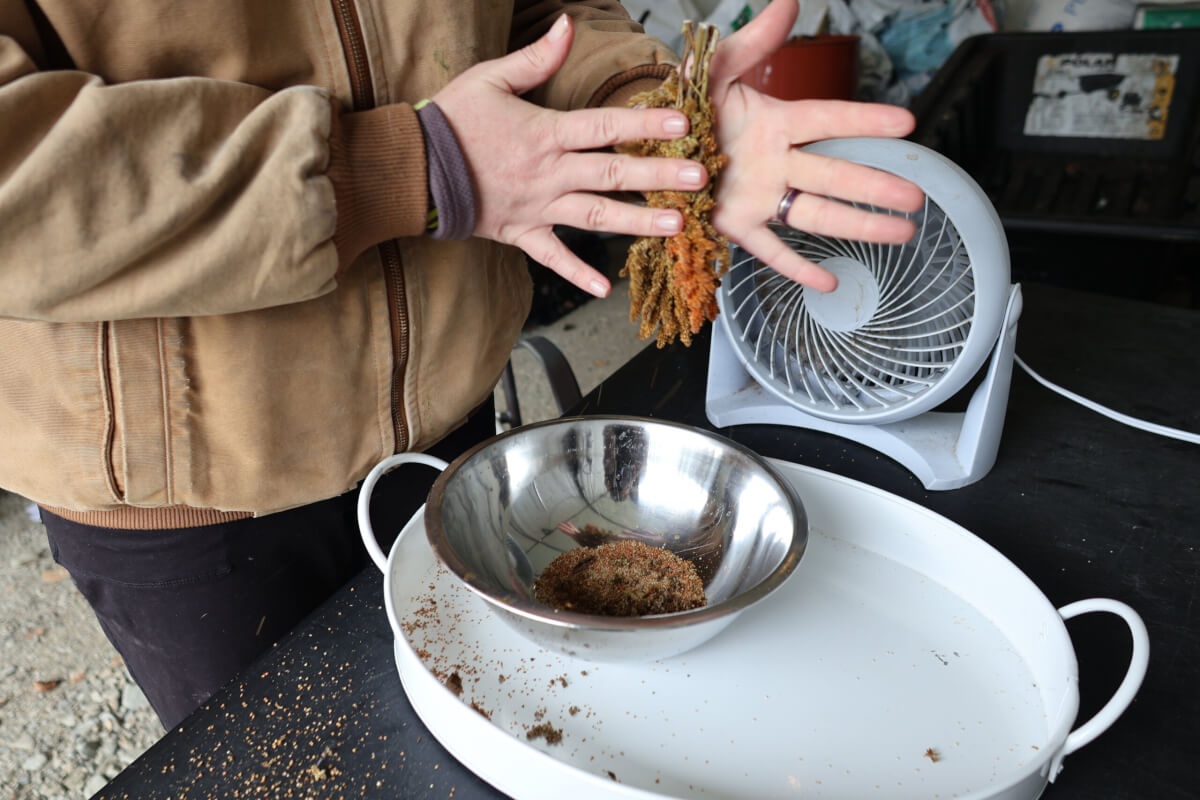
We practiced a new to us technique called wind rowing. The gist is that one uses a fan to blow the seed and chaff. The heavier seeds fall to the desired collection plate, whereas the lighter chaff gets blown off into the distance. It’s a very low tech, but reasonably effective means of processing harvested grains at the DIY home scale.
Out of the four “giant amaranth” plants we grew, we harvested about a typical grocery bag’s worth of amaranth flowers. For growing them directly in subarctic soils, this seemed to be a fairly decent harvest. We weren’t sure what to expect, and maybe were hoping for “more giant,” but a grocery bag’s worth was something.
The harvested seed, however, became less and less volume as we processed the flowers with wind rowing. In the end, that grocery bag ended up being a few tablespoon’s worth of actual grain. It certainly wasn’t enough to justify further processing, such as turning the harvest into flour.
However, a few tablespoon’s worth of whole grains can be valuable! We’ve saved the grains and can use it as a topper on salads, in smoothies, toss some into a bowl of cereal or just as an extra something-special in many things. Whole grains do provide a number of health benefits that are difficult to get otherwise.
It’s interesting to consider something like this at scale. Clearly, one would need to grow a lot of amaranth plants to harvest a meaningful amount of grain. But, if you’re pursuing whole grains with plants that don’t require mechanization, amaranth is on a pretty short list of viable options. But, labor requirements would significantly increase with growing scale, too.
I can’t say that we’d want to perform a day’s worth of wind rowing. It’s fun for a couple hours, but that’s about it. It’s also not all puppies and rainbows, either, it requires a bit of re-processing to get it down to actual pure grain. It’s hard to justify the economic output when the labor requirements are as high as they are.
We’re going to give these pursuits some more thought over the winter. While the idea of growing, harvesting and processing our own grain is appealing to us for several reasons, we’re conflicted on the question of whether the “juice was worth the squeeze.” It’s not expensive, at all, to just buy whole grain.
But, we figured a follow up was appropriate and that you might be interested in the actual processing of grains, at home!
