
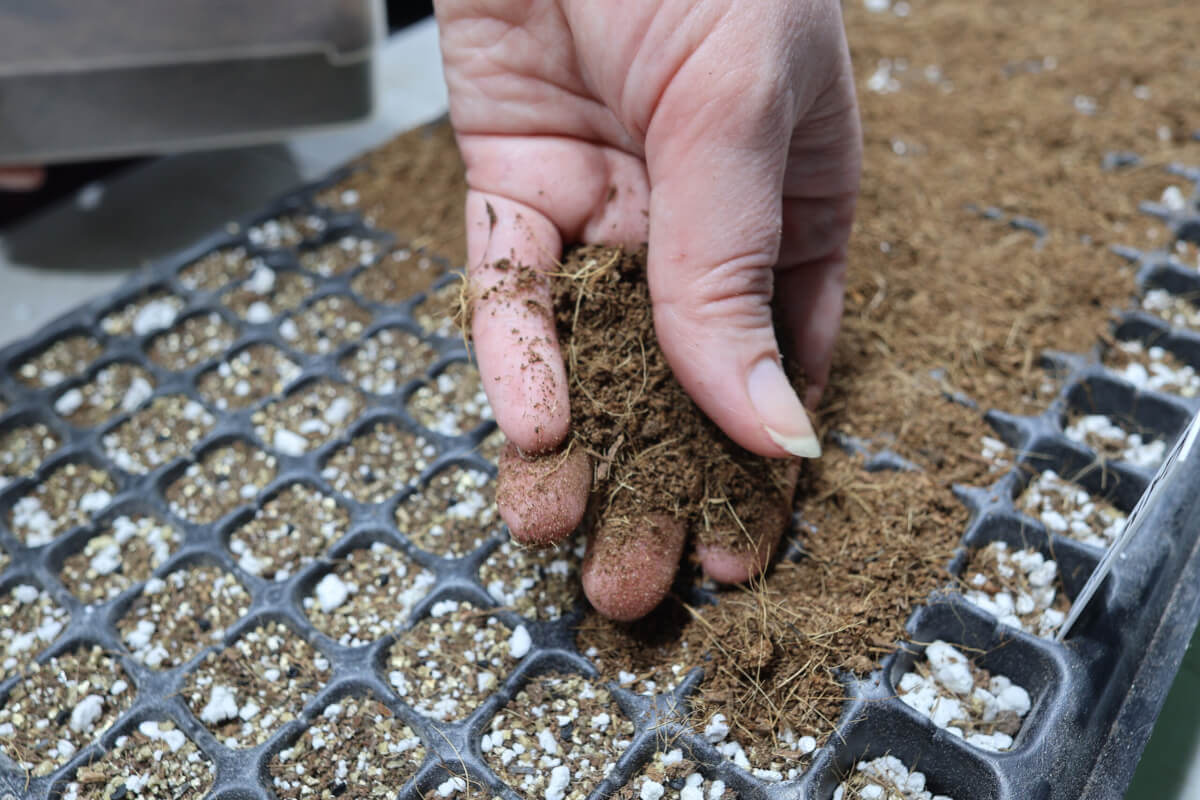
The super observant among you might have noticed that the top soil on our seeding trays look a little bit different than it has in year’s past. Let’s talk about what’s changed in our germination process!
We’re now using coco coir to “top off” our seeding trays. When we are sowing, we basically use a surface sow process, then we add additional soil on top of the seed to meet the seed sowing depth of each seed. This allows us to precisely control the sowing depth of each seed, whether it requires a little or a bit more covering.
We’ve found a number of benefits to using coco coir as our “topper.” Since it’s so visually distinctive from our seedling soil, we get instant feedback on how well covered our seeds are. Coco coir is also relatively non-bioactive, so it helps the top of the soil resist algae growth more than regular soil.
We’ve also found that seeds have a bit easier of a time pushing through the coco coir, at least opposed to pieces of perlite that would be a heavy lift for those seeds. The coco coir also visually indicates the moisture level within it quite well, so it’s also a bit easier to tell how well watered our seeding cells and seedlings are.
We’d definitely say this isn’t strictly a necessary step, you can simply cover your seeds in whatever soil you’re using. It is definitely more cost and effort to maintain two different materials. It’s not like we are significantly increasing survival rates with this change, it’s mostly just a quality of life thing.
But, if coco coir (or even peat moss) is something you keep on hand, you might want to play with this technique. We started playing with the technique last season and decided to keep the practice through this season. The more we use it, the more we are preferring it!
