
Let’s talk about a major shift in how we fertilize our large in-ground gardens each season. At a certain point, our plants become quite large and fertilizing with watering cans becomes a lot less practical.
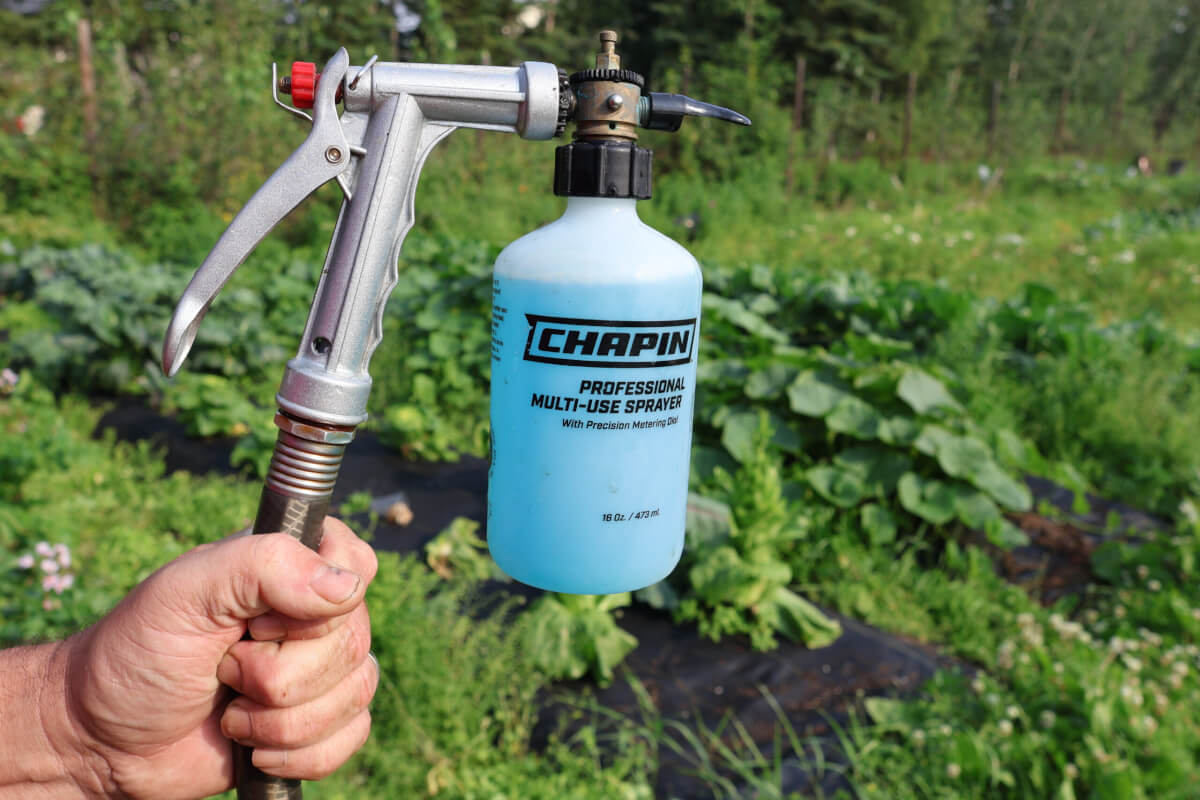
This tool is called a hose-end sprayer and it’s the optimal way to spread water soluble fertilizers over large spaces. It continuously mixes a concentrated fertilizer solution, with relative precision, to allow the gardener to achieve the ideal application rates for the fertilizer being used.
These tools are very much a “you get what you pay for” kind of thing. The cheap ones are crummy, cheap, break easily and don’t work well. We’ve grown to trust the professional line of the Chapin brand, they are built for relatively heavy duty and hold up to multi-season use. This one is no longer made, but if we were buying today, we’d get the G364D model.
The real benefit of using this tool is that it allows you to use what is called foliar feeding. Plants can take up nutrition through their leaves, so when you’re able to get a little bit of NPK on them, it goes directly into the plant. We believe this is slightly more efficient than taking up nutrition through the roots as it gets the NPK right where it’s needed.
Plus, you can also more easily cover a larger area of ground, which is helpful for your plant’s larger root systems later in the season. The general “rule of thumb” is the plant’s root structure is roughly as wide and deep as the plant is wide and tall. That helps us visualize where the fertilizer should be applied to allow maximum uptake across the root system.
We’ve long had a philosophy that walking paths in the garden are sort of “wasted space.” You’ll note that we allow our squash to pretty much take over the walking paths entirely, especially as we advance further into the season. Our crops are “smartly” laid out so we still have some access for watering and fertilization, while offering the bulk of the space to the plants. The hose-end sprayer fully integrates into this philosophy, allowing us to “fert from afar.”
The most challenging thing about using this method is determining the needed strength of the fertilizer concentrate. In our case, we create a fairly strong concentrate that is then watered down in the sprayer itself, then again upon application. It’s not calculus or anything, but it does take a bit of noodling to figure out how to end up with the right amount of fertilizer out of the sprayer. We might do a post on this in the future as it looks like we may need to do up a batch of concentrate later this season.
We are pretty much fertilizing this garden once a week these days and this tool is how we keep it sane and fast. Even though we’re at peak summer right now, it’s not lost on us that we really only have about 45 remaining frost free growing days left. This stuff is truly a race against time and that’s a big part of why we use the methods we do.
