
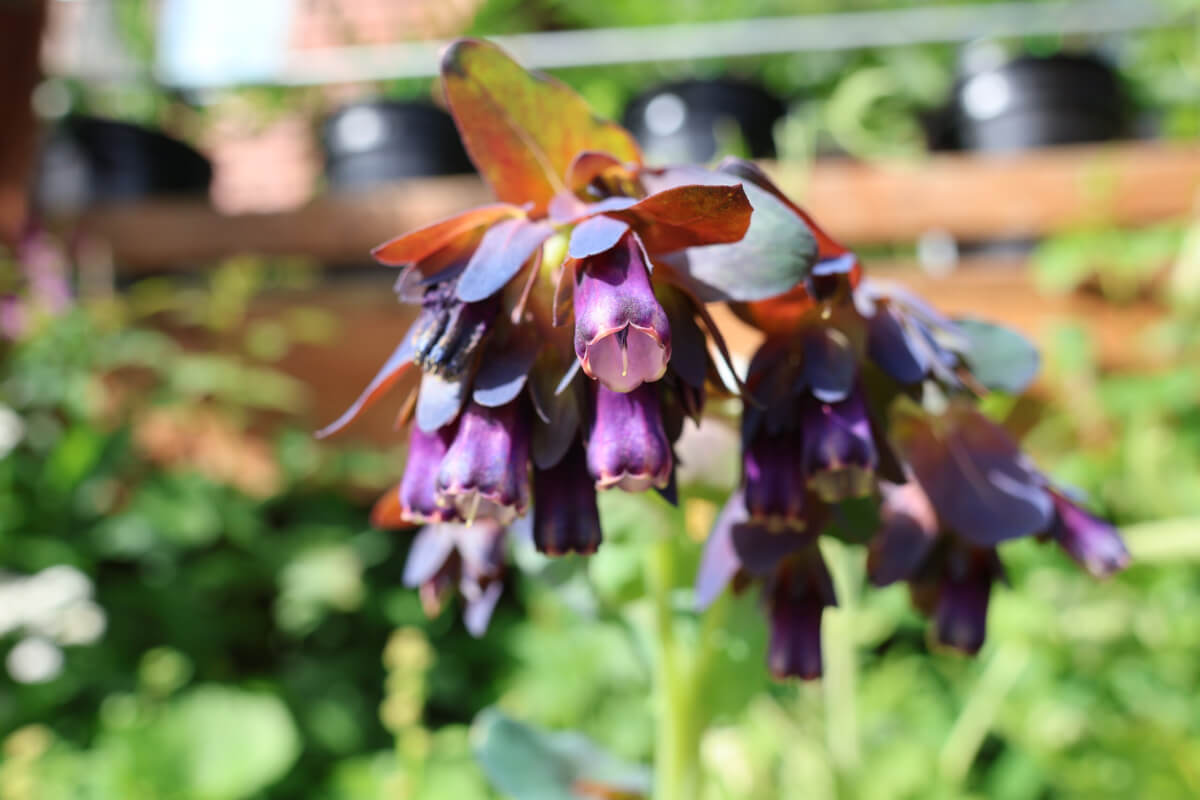
Well, we do have to apologize. Last week completely got away from us and apparently we completely missed Flower Friday! So, we’ll make up for it with an extra special flower from our gardens this week!
We discovered Honeywort back in 2021 in an attempt to bring in more varieties of nectar producing flowers into our gardens. Also known as Cerinthe Major Purpurescens, Honeywort hails from the Boraginaceae family. You Alaskan’s are likely familiar with this family, since our state flower “Forget Me Not” is also a member of this family. Honeywort has quickly grown to become one of our garden favorites and we’ve been growing it ever since!
Of all the flowers we grow, these Honeywort are the hands down favorite of our bumblebees. They are always covered in them! It’s hilarious to watch their chunky bodies get into these small flowers! “If I fits, I sits!” they say! Honewort produces large quantities of nectar, thus helping us complete our pollinator’s food chain between both pollen and nectar. If you’re growing at lower latitudes, Honeywort will also attract Hummingbirds as well.
This link with bees has been known since ancient times. In fact, the Greek etymology of Cerinthe (keros anthos) essentially translates to “beeswax flower.” This reflects the mistaken understanding, of that time, where it was commonly believed that bees extracted wax from flowers to produce their honeycombs.
Though this flower is not exactly common to see used in culinary circles, the flowers are completely edible. They provide a subtly sweet flavor, which is remarkably absent of vegetal flavors you might see in other edible flowers. The flowers can be used as a decorative addition to salads, desserts and cocktails.
Honeywort is not commonly used for medicinal purposes. Despite this, they are no stranger to many medicinal and naturopathic focused gardens. In traditional medicine, the flowers are reported to act as an analgesic, sedative and can also stimulate the immune system. This indicates potential for strong bioactivity, but we haven’t seen evidence of this flower being studied for uses in more modern pharmaceutical applications.
Cerinthe is native to the Mediterranean and Portugal. In these warmer latitudes, the flower can be both a short lived perennial and Cerinthe is also known to self-seed. We find that our short season doesn’t offer enough time to produce seed pods, so they are strictly an intentionally grown annual in northern gardens.
Though Honeywort isn’t much to look at from a distance, getting up close on this flower reveals a very different picture. It’s a very important one for our pollinator ecosystem and the purple tubular flower’s are quite attractive. We love growing it and our bumblebees highly approve! Honeywort will be a staple “filler plant” for many years to come in our flower gardens!
