
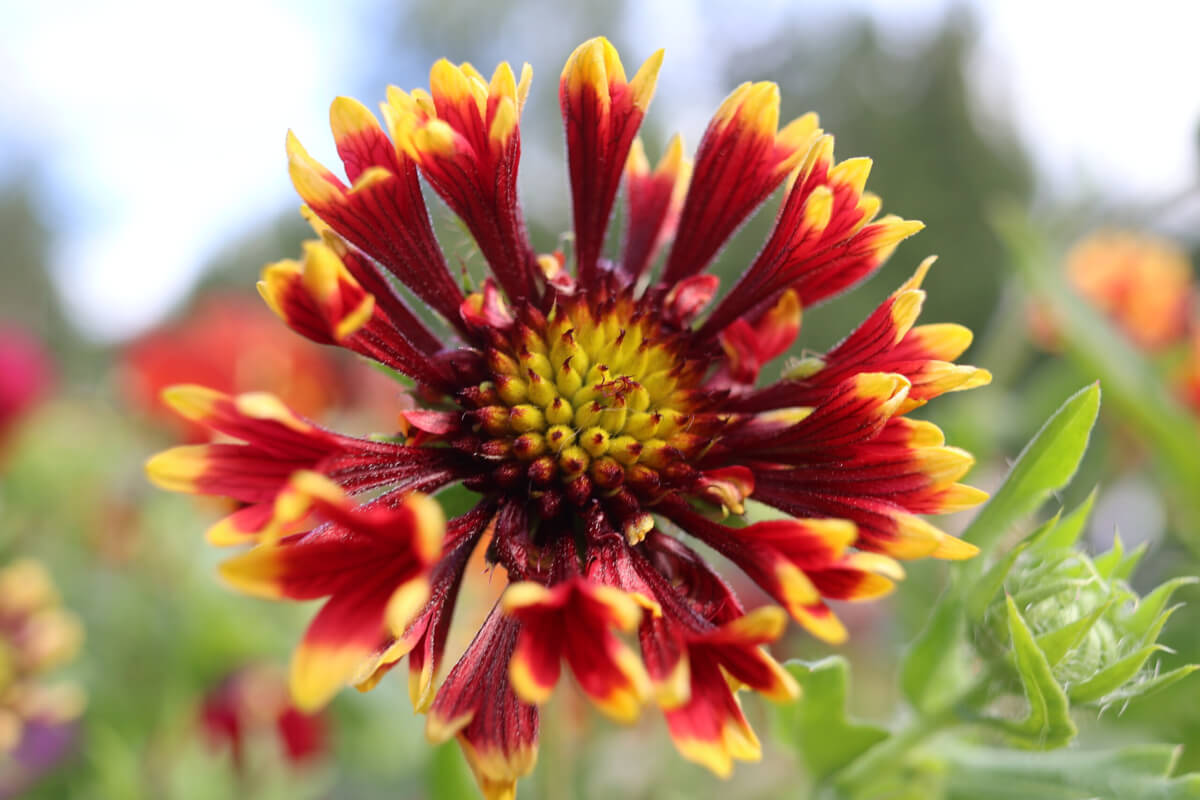
It’s a late night Flower Friday for this one! We’re digging through our archives to make sure we hit all the species! And this is one we haven’t ever talked about!
This flower is perhaps obviously a member of the asteraceae family, but it’s definitely among the more obscurely grown in the garden within that family. Gaillardia, certainly among the more colorful in the aster world of flowers, was named after an 18th century French Magistrate (Maître Gaillard de Charentonneau) who had a strong affinity towards botany.
The alternate name, blanket flower, is often thought to be related to the brightly patterned blankets crafted by Native Americans. The color array in this species very much reminds us of colors commonly used in native arts, so it should not be a surprise that gaillardia is native to both north and south America. This flower can be natively found across most of western North American, from Canada to New Mexico.
This flower’s varieties can present in a wide number of colors, such as yellow, orange, red, purple, brown, white and bi-colored such as you see here. Like many flowers in the aster family, it is comprised of a tubular disc of florets, craftily surrounded by over a dozen ray florets or petals. Curiously, though, it is also not uncommon for some species of Gaillardia to produce a large plume of florets instead.
Given the north American heritage of the flower, we see its medicinal uses primarily emerge in indigenous medicine. For example, the Nlaka’pamux of western Canada used Gaillardia to treat tuberculosis, as a pain reliever and was often used as a first-line “general disease” remedy. The Syilx utilized the flower for treatment of kidney issues, orthopedic problems and analgesic as well. This pattern continues throughout indigenous cultures, with the roots being used for treatment of gastroenteritis, skin disorders and even an eyewash for horses. The roots are often said to act as an anesthetic when chewed.
Where we see medicinal use, we’ll often also see some form of culinary application. Given this flower’s native area being in the Americas, again, we see culinary adoption through native cultures. The Navasupai people would dry and then ground the seeds into a sort of seed butter. It is also known that the Niitsitapi (or Blackfeet) people would often use Gaillardia flowers in soups or broths. However, despite these uses in of Gaillardia as both food and medicine, we haven’t seen wider adoption into modern food or pharmacological medicine.
We find Gaillardia optimal for container based gardens. They are rather draught tolerant and thus deal well with the ebb and flower of water availability in smaller containers. However, they can also be used for ground effect, often spreading out and covering a good bit of ground. They are welcome additions to our cut flower uses, typically producing decent sized stalks with a singular, attention drawing flower.
Our general preference has been to grow mixes of Gaillardia, allowing us to get a wide sampling of everything this wonderful flower has to offer. We’re currently growing out the Lollipop mix and have definitely appreciate the vibrant displays and great variety. We try to mix up our seed types when we run out, just to continually keep things fresh!
We’re glad to finally get around to demonstrating this flower and are perhaps a bit surprised this is the first time we’ve really shown it! It’s certainly not by lack of growing it as it’s been a favorite of ours for quite a few years now! Have a great weekend, everyone!
