
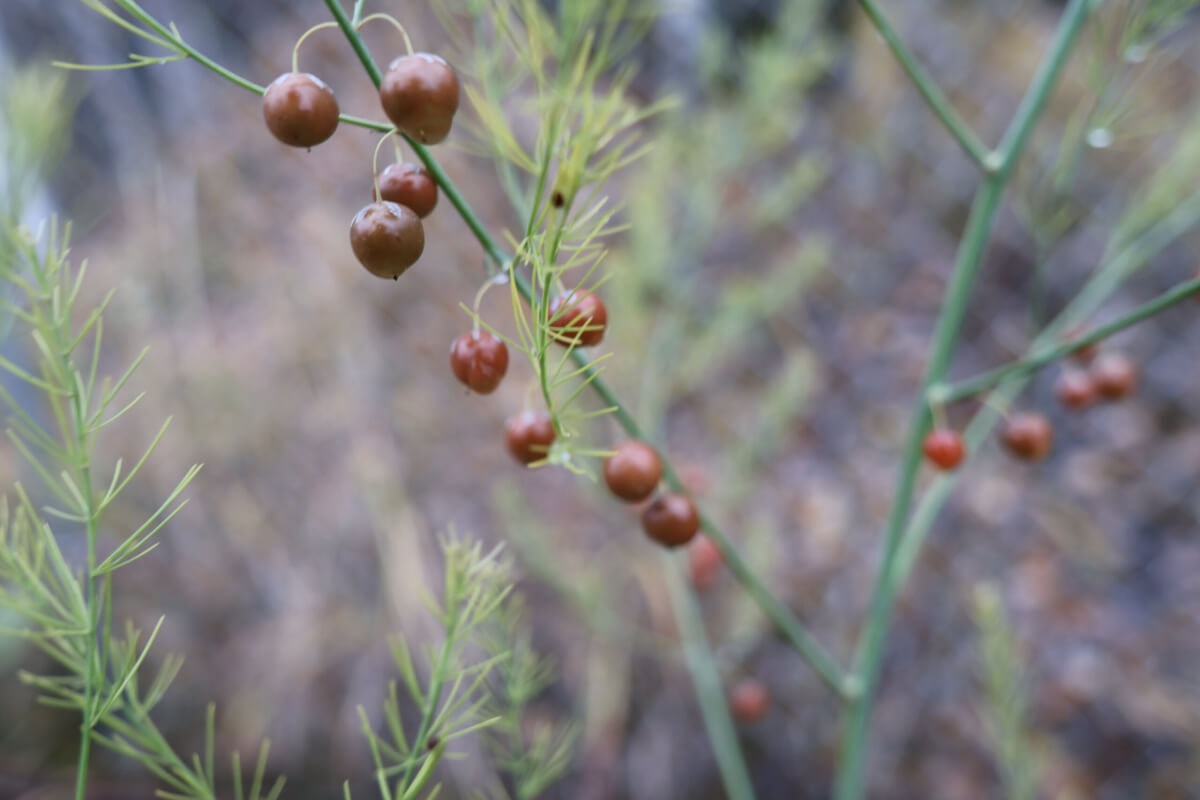
We had something pretty exciting happen with our asparagus this year! We got berries! This might not seem like much to the experienced asparagus grower, but it’s a huge step in our learning process with growing this plant.
For the uninitiated, let us explain. Asparagus have distinct male and female plants, a biological trait called dioecious. This is important from a yield perspective as the male plants typically produce thicker and more plentiful stems and thus are strongly desirable to maintain in the perennial asparagus garden. They are what you want to grow to max those harvests.
We’ve struggled with sexing our asparagus plants over the last several years. While there are several possible test methods for this, we’ve found them to be somewhat unreliable or inconclusive. Things like stem size can be used as a possible indicator, but “bigger” is a subjective thing and is difficult to discern by the amateur asparagus grower.
Well, these berries are a definitive indicator of a female plant. However, in all the years we’ve had our asparagus perennial bed, this is the first year they’ve produced these berries. It appears to have taken about four years for us to get to this point, much longer than we might have expected. But, subarctic perennials grow and mature much more slowly, also as expected.
Our “master plan” is to eventually transplant male asparagus plants into a “real” asparagus garden. Our current beds are where we’ll develop new asparagus perennials from seed, but once they’re properly sexed, the most beneficial plants can be moved into a garden more focused on actual asparagus production.
This also may give us a chance to test asparagus reproduction at subarctic latitudes. In theory, these berries can drop into the soil and may germinate the following spring. We’ve found this process generally unreliable across many plants at subarctic latitudes. Just because something “can” do it, doesn’t mean it happens at 65 degrees north.
We’re very glad to see this as it has now removed all doubts we had. We’ve now marked the female plants, which will allow us to cull them next spring. We figure we’ll at least give them one more run, eat the result, and then replace those plants with a new batch of seed grown asparagus next season.
We’re learning that growing asparagus at far northern latitudes is a rather long game. We usually expect this with our perennials, but information out there seems to suggest asparagus will produce berries after a couple of years. That appears not to be exact, given an extreme cold climate.
Oh, and in case you’re also on a similar path, it’s probably important to state that these berries are toxic and should not be eaten. They won’t seriously harm you, but you’ll likely have a pretty bad day.
This was an exciting development in this learning process. I was starting to question if we even had the season length to support the berry creation. Turns out we do, it’s just on a much longer time scale!
