
If you want to skip forward to our planting schedules, minus the preamble, click your appropriate northern zone.
Zones 0A to 1B Planting Schedule
Zones 2A to 4B Planting Schedule
Zones 5A to 7B Planting Schedule
Zones 8A to 8B Planting Schedule
The information presented on this page is entirely geared to be used along with the Frosty Garden seed planting schedule for vegetables and flowers for Interior Alaska and our general recommendations for northern climates.
If you just want “easy,” use our downloadable seed planting schedules for your appropriate zone! We lay out out, date by date, and have done all the hard work for you. It’s not as comprehensive, but it works!
Our sowing schedules use the number of weeks, prior to last frost, as the indicator of when YOU should be planting seeds for your area.
If this seems complicated, this is the best way to think about seed sowing schedules. Most garden guides will tell you, “Plant X number of weeks to last frost” so it’s good to be familiar with how that process works. Getting “used” to this method will prepare you to grow anything!
The dates on these schedules tell you when those planting dates are, in your particular growing zone.
If you’re still not sure what this is about, read on!
A Primer On Our Alaska Seed Planting Schedules
In our effort to be a regional gardening guide for extreme northern climates, one of the important things we need to distinguish are seed planting schedules across the many climates “the north” has.
The challenge we face, attempting to be a growing guide for all of Alaska and “the north”, is immense.
There are extremes between areas where trees can barely grow (zone 0 and 1) to areas that can might as well be tropical by “northern standards.”
These are worlds apart in experience, as you might imagine. It’s the difference between starting your seed planting in January or March!
In USDA zones 1 through 4, we are in a race to make our gardens work in the short summer we have. There is little room for error.
In warm zones, 5a+, there is a bit more flexibility and longer, valuable growing season.

This shows how the various growing zones work in relationship to minimum low winter temperatures. Alaska occupies nearly 2/3 of these zones!
Some battle coastal influence, which can significantly influence climate conditions. Some are in mountainous areas, which can also radically adjust the expected climate.
Furthermore, you might notice that growing zones are defined by specific, geographic areas. If growing zone line (between say, 4b and 5a) cut in between you and your neighbor’s house, is their climate radically different from yours?
No!
You might find it best to fine tune our schedules to your specific experience.
We separate ours by a month each, as that’s how the “general growing world” thinks about these things. You might find it better to shift it a week or two in either direction for your specific circumstances.
To many degrees, it’s upon the individual gardener to understand their climate well and determine their growing process (and schedules) for themselves.
Our goal is to give you accurate, northern-focused guidelines that help you get there.
Figuring Out Your Growing Zone
We decided to use the USDA growing zones to provide general guidance, as there is a strong correlation between these and general last frost dates.
This is one of the highest quality USDA growing zone maps we have for Alaska. You can use this to generally pinpoint your growing zone.
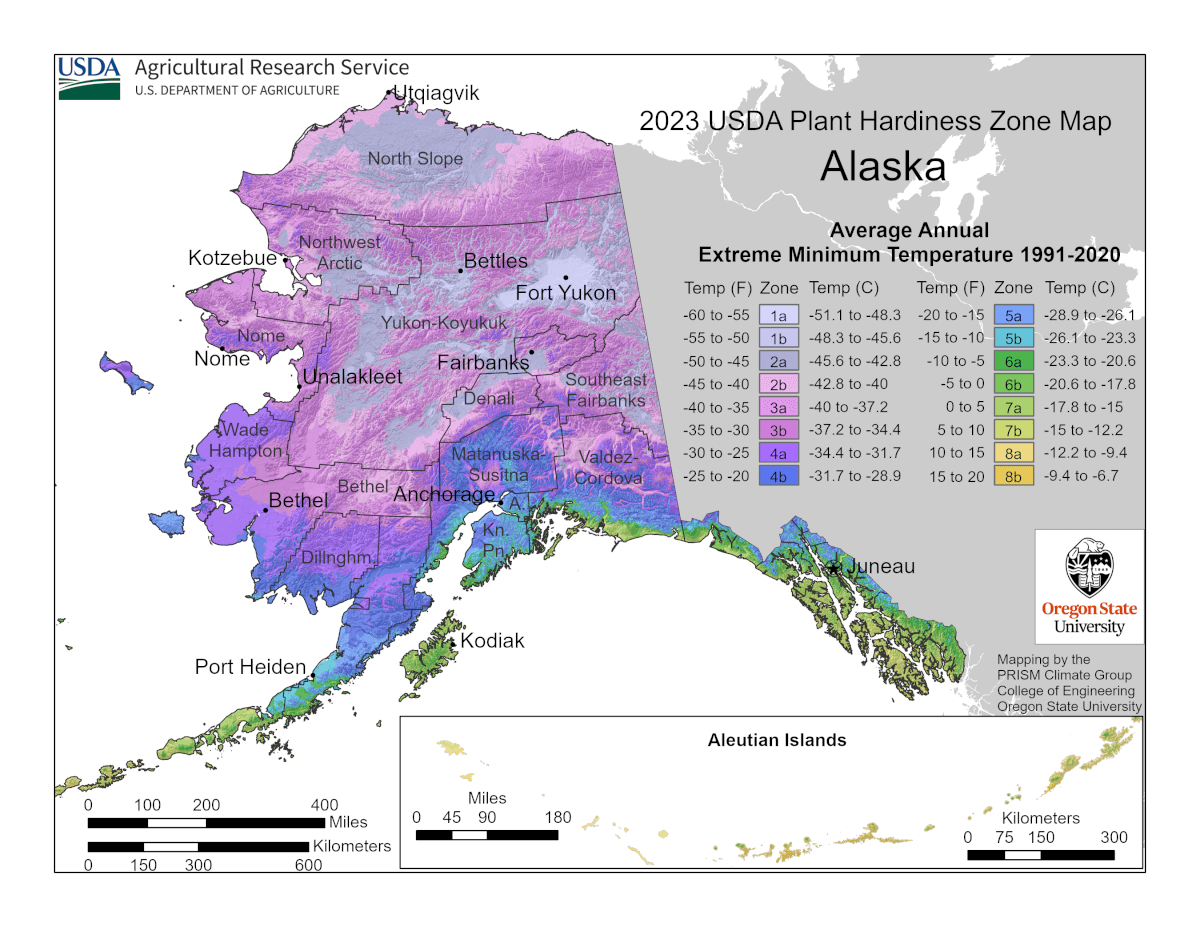
Click the image to expand the full map!
The USDA’s hardiness zone map features street level data with hardiness zone overlays.
The information in this guide can absolutely be transferred to other northern growing areas, as well. We’ve provided suggested latitudes, last frost dates and various Alaskan towns that can be used to hone in on which planting schedule is right for you. Latitude is what matters the most!
Zone 0a-1b Seed Planting Schedule
Zone 2a-4b | Zone 5a-7b | Zone 8a-8b
Alaska Location Examples: Utiagvik, Wainwright, Atqasuk, Prudoe Bay, Point Hope. Also most northern mountain climates above 62N.
- Approximate last frost date: ~June 15th (When you transplant outside!)
- Approximate latitudes: Greater than 68 degrees north, some areas of eastern Canada near Hudson Bay
- Approximate total growing days: 40 to 75
This is, beyond any doubt, the most challenging of all Alaskan growing zones.
Truth be told, better than 75% of our seed schedule will not grow to full maturity within this zone, given the average summer season. If we have major garden tips for growing in this zone:
- Plan on crops that mature in the 30-60 day range. Primarily cold-climate friendly crops, generally speaking. These include:
- Greens (head & leaf lettuce, kale, Japanese greens, dandelion)
- Fast, cold climate growers (radish, bok choy, some early pea varieties)
- Microgreens (all varieties)
- Herbs will produce to some degree, even in short season
- Broccolini, ~50 day varieties
- There are some specialty varieties of various crops that can be expected to mature in <60 days. This is typically defined as the transplant date, so you only need 60 days of outdoor growing.
- Expect first frosts as early as July to August in many of these locations. There is an incredible amount of nuance in your exact micro-climate and actual capabilities.
- Use season extension techniques (greenhouses, low/high tunnels, heating, container gardening, indoor growing techniques) when possible.
- For longer range crops (> 60 days), expect to sow weeks to months earlier if you want to grow them. Expect mostly indoor growing, with little advantage and opportunity to transplant outdoors permanently.
Despite the challenges explained above, this is our corrected seed planting schedule for these regions. There is also some merit to following the 2a-4b schedule as this schedule will generally ensure “more mature” plants. Keep in mind, this will also increase your indoor growing requirements.
Vegetable Seed Schedule | Flower Seed Schedule
| Weeks To Last Frost: | Date: |
|---|---|
| 12 Weeks To Last Frost: | 3/23/2026 |
| 11 Weeks To Last Frost: | 3/30/2026 |
| 10 Weeks To Last Frost: | 4/6/2026 |
| 9 Weeks To Last Frost: | 4/13/2026 |
| 8 Weeks To Last Frost: | 4/20/2026 |
| 7 Weeks To Last Frost: | 4/27/2026 |
| 6 Weeks To Last Frost: | 5/4/2026 |
| 5 Weeks To Last Frost: | 5/11/2026 |
| 4 Weeks To Last Frost: | 5/18/2026 |
| 3 Weeks To Last Frost: | 5/25/2026 |
| 2 Weeks To Last Frost: | 6/1/2026 |
| 1 Weeks To Last Frost: | 6/8/2026 |
| 0 Weeks To Last Frost: | 6/15/2026 |
| +1 Weeks From Last Frost: | 6/22/2026 |
| +2 Weeks From Last Frost: | 6/29/2026 |
Zone 2a to 4b Seed Planting Schedule
Zone 0a-1b | Zone 5a-7b | Zone 8a-8b
Alaska Location Examples: Fairbanks, Anchorage, Nome, Kotzebue, Palmer, Soldotna, Coldfoot, Tok, Bethel, Willow, Wasilla, Talkeetna, Unalakleet, King Salmon, most Alaskan mountain climates
- Approximate last frost date: ~June 1st (When you transplant outside!)
- Approximate latitudes: ~62 degrees north to ~68 degrees north
- Approximate total growing days: 95 to 120
This is our bread and butter. The zone that we ourselves find ourselves practicing within.
We can grow many things. Not all things, but our climate allows for a lot of flexibility.
The recommended seed planting schedule we present is 100% geared towards these growing zones.
Some areas of South Central Alaska (e.g. Anchorage area) may be able to use the 5a-7b schedule. This will entirely depend on your last frost dates in your particular area.
Vegetable Seed Schedule | Flower Seed Schedule
| Weeks To Last Frost: | Date: |
|---|---|
| 12 Weeks To Last Frost: | 3/9/2026 |
| 11 Weeks To Last Frost: | 3/16/2026 |
| 10 Weeks To Last Frost: | 3/23/2026 |
| 9 Weeks To Last Frost: | 3/30/2026 |
| 8 Weeks To Last Frost: | 4/6/2026 |
| 7 Weeks To Last Frost: | 4/13/2026 |
| 6 Weeks To Last Frost: | 4/20/2026 |
| 5 Weeks To Last Frost: | 4/27/2026 |
| 4 Weeks To Last Frost: | 5/4/2026 |
| 3 Weeks To Last Frost: | 5/11/2026 |
| 2 Weeks To Last Frost: | 5/18/2026 |
| 1 Weeks To Last Frost: | 5/25/2026 |
| 0 Weeks To Last Frost: | 6/1/2026 |
| +1 Weeks From Last Frost: | 6/8/2026 |
| +2 Weeks From Last Frost: | 6/15/2026 |
Zone 5a to Zone 7b Seed Planting Schedule
Zone 0a-1b | Zone 2a-4b | Zone 8a-8b
Alaska Location Examples: Juneau, Ketchikan, Sitka, Kodiak, Homer, Valdez
- Approximate last frost date: ~May 1st (When you transplant outside!)
- Approximate latitudes: ~58 degrees north to ~62 degrees north
- Approximate total growing days: 150 to 180
These zones bring much opportunity and generally much less conflict with growing food, flowers and many perennials.
Care does need to be taken around typical frost dates, in general, but these areas provide very functional “northern climate” growing abilities.
Some areas in this region may need to follow the 2a-4b planting schedule, typically higher elevations. This will highly depend on your particular microclimate and typical last frost dates.
Vegetable Seed Schedule | Flower Seed Schedule
| Weeks To Last Frost: | Date: |
|---|---|
| 12 Weeks To Last Frost: | 2/6/2026 |
| 11 Weeks To Last Frost: | 2/13/2026 |
| 10 Weeks To Last Frost: | 2/20/2026 |
| 9 Weeks To Last Frost: | 2/27/2026 |
| 8 Weeks To Last Frost: | 3/6/2026 |
| 7 Weeks To Last Frost: | 3/13/2026 |
| 6 Weeks To Last Frost: | 3/20/2026 |
| 5 Weeks To Last Frost: | 3/27/2026 |
| 4 Weeks To Last Frost: | 4/3/2026 |
| 3 Weeks To Last Frost: | 4/10/2026 |
| 2 Weeks To Last Frost: | 4/17/2026 |
| 1 Weeks To Last Frost: | 4/24/2026 |
| 0 Weeks To Last Frost: | 5/1/2026 |
| +1 Weeks From Last Frost: | 5/8/2026 |
| +2 Weeks From Last Frost: | 5/15/2026 |
Zone 8a to 8b Seed Planting Schedule
Zone 0a-1b | Zone 2a-4b | Zone 8a-8b
Alaska Location Examples: Adak, Unalaska, much of the Aleutian Islands, some of Southeast Alaska
- Approximate last frost date: ~April 1st (When you transplant outside!)
- Approximate latitudes: ~53 degrees north to ~58 degrees north
- Approximate total growing days: 210 to 240
We are definitely jealous of those growing in these climates! The growing world is entirely open to you!
Things fundamentally change a bit when growing in this zone and above. With such a vast number of possible growing days, there is much opportunity for multiple harvests with some plants.
You can get started early to get an early crop, but there’s a lot more wiggle room than us colder climate growers experience.
In general, you want to aim cold climate crops towards the beginning or ends of the season to take advantage of cooler weather. Warm climate crops should be aimed towards peak summer season and allowed to mature into fall.
Some people in these regions may need to follow the 5a-7b schedule, typically depending on your elevation, coastal influence and average last frost date.
Vegetable Seed Schedule | Flower Seed Schedule
| Weeks To Last Frost: | Date: |
|---|---|
| 12 Weeks To Last Frost: | 1/7/2026 |
| 11 Weeks To Last Frost: | 1/14/2026 |
| 10 Weeks To Last Frost: | 1/21/2026 |
| 9 Weeks To Last Frost: | 1/28/2026 |
| 8 Weeks To Last Frost: | 2/4/2026 |
| 7 Weeks To Last Frost: | 2/11/2026 |
| 6 Weeks To Last Frost: | 2/18/2026 |
| 5 Weeks To Last Frost: | 2/25/2026 |
| 4 Weeks To Last Frost: | 3/4/2026 |
| 3 Weeks To Last Frost: | 3/11/2026 |
| 2 Weeks To Last Frost: | 3/18/2026 |
| 1 Weeks To Last Frost: | 3/25/2026 |
| 0 Weeks To Last Frost: | 4/1/2026 |
| +1 Weeks From Last Frost: | 4/8/2026 |
| +2 Weeks From Last Frost: | 4/15/2026 |
If you have any comments, corrections or specific regional advice, we would love to hear it! Slap a comment below if you have something to add.
Hi. What about Wasilla,.AK?
For Wasilla, we generally advise using our “default” 2A-4B schedule and planning for a last frost of June 1st. While much of Anchorage and the valley are “technically” zone 5, and “theoretically” have a last frost date of May 1st, growing on the very edge of a growing zone can be very challenging. We’ve heard many reports of people having troubles being too aggressive (i.e. aiming for May 1st) and losing their plants to late frosts. If you were trying to achieve optimal timing, you could probably shift average last frost dates a couple of weeks (e.g to May 15th or May 21st) and that would likely coincide with seasonal realities.
List my Partner..So I Am so late…live in Wrangell ak…What Can I Grow..We gave a Greenhouse an Raised Beds Outside…We have always Grown Everything..,
So sorry to hear about that! Fortunately, right now, we are still very early in this year’s growing season. If you are starting seeds indoors, you can start with anything that is 9-10 weeks to last frost or later. If you don’t have an indoor growing space, we can highly recommend using winter sowing techniques for things like broccoli, cabbage, lettuce/greens, chard and many other things. (We don’t have a great article on this technique, but you can google it and it’s very easy.) You can also direct sow a lot of things into your beds like carrots, lettuce & greens, radish, beets, spinach, turnip and many other things. If you’ve got some time, we’ve got a ton of articles that will aid you. Plus, check out our social media (YouTube & Facebook) as we’re regularly putting out updates on what we are up to and other helpful info!
Ohh my Gosh…I’m Sorry..I “Lost” My Partner…I “Have” a Greenhouse an Beds outside…