
Listen To This Article!
Over the winter of 2024, I immersed myself in studying pH (or potential hydrogen) and its role in soil-based gardening and farming practices.
This article aims to show you the advantages of achieving the ideal pH within your container garden, as well as the methods we used to adjust and control the pH of our own container gardens.
pH is a measure of how acidic or basic something is. In this case, we’re talking about soil.
The pH scale ranges from 0 to 14, with lower numbers indicating acidity and higher numbers indicating alkalinity (or basicity). As you might remember from Chemistry 101, a pH of 7.0 is considered “neutral.”

I’ve long suspected that some of our container gardening challenges were related to pH issues, which I’ll discuss further in this post.
We’ll keep things simple, as understanding pH can get quite complex. We’ll try to keep the information accessible for the average gardener.
However, it’s important to note that managing pH is an advanced gardening technique used to achieve optimal growing conditions. It’s not for beginners and, if done incorrectly, can cause more harm than good.
While it’s beneficial for beginners to be aware of pH, it’s not the key factor in determining success or failure in gardening.
A Primer On pH And Growing Plants In Containers
You’ve likely come across the concept of pH in gardening before. There are numerous products designed to help adjust the pH of both soil and hydroponic systems.
As advanced gardeners, we’ve come to appreciate just how much chemistry is involved in growing plants. And indeed, all life.
Consider this: when we eat food, it’s not the broccoli or chicken sandwich that sustains us directly. Instead, it’s the starches, proteins, fats, amino acids, and other nutrients our body extracts from that food.
This process occurs through a very complex chain of biological and bio-chemical processes.

Plants operate similarly, but with key chemicals like nitrogen, potassium and phosphorus. But, there is also similarity to humans, such as with starches, sugars, and proteins.
Getting back to pH, each plant has an “ideal” pH range where it thrives best. This optimal pH level ensures the best nutritional uptake; deviations can hinder a plant’s ability to absorb necessary nutrients.
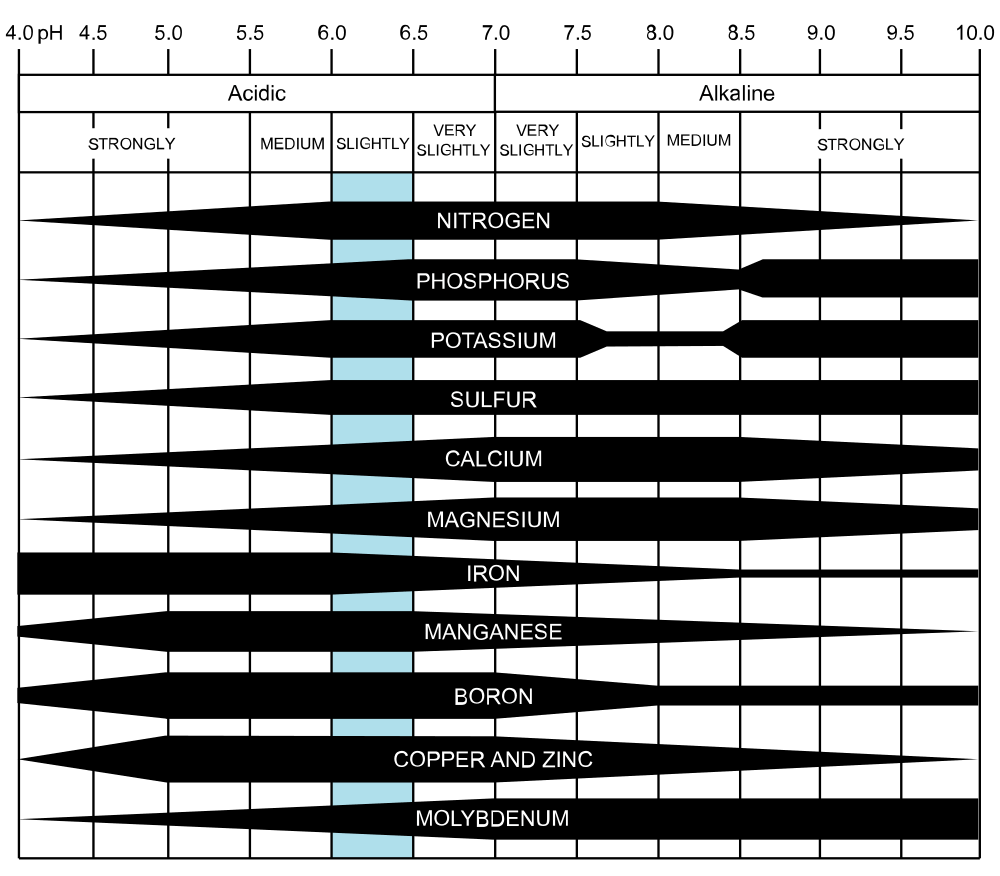
The above image illustrates how pH affects nutrient uptake. The further the pH is from the ideal range, the less of a given nutrient the plant absorbs. Extreme pH levels, too high or too low, can lead to nutritional deficiencies that are hard to diagnose.
Also, let’s clarify. Not ALL nutritional deficiencies are pH related. There are many other possible causes of plant problems, most of which have nothing to do with pH.
Some plants prefer more acidic soils, like blueberries, raspberries, and rhododendrons. Gardeners often adjust soil pH with additives based on these preferences.
However, most plants do not thrive at extreme pH levels; the acceptable range is typically between 5.0 and 8.0. For most plants, a slightly acidic pH of 6.0 to 6.5 is ideal.

It’s crucial to understand that there isn’t one “perfect” pH for every plant, but rather an acceptable range.
Additionally, pH is not a stable value; it can be influenced by factors like compost, fertilizer, water, the plant grown and soil composition. In nature, various elements work together to maintain a balanced pH in the soil.
However, when gardening in containers, we isolate plants from these natural influences. Containers limit the external factors that would otherwise help regulate soil pH.
Factors That Influence Soil pH
As mentioned earlier, many factors ultimately determine soil pH, especially in “crafted” soils where gardeners use additives for better structure, water drainage, and aeration.
One common additive is peat moss, which helps with water retention and reducing soil compaction. However, peat moss is acidic and can lower the soil’s pH.

To counteract this, it’s often recommended to add dolomitic limestone. But remember, pH isn’t static; these additives feature what’s called a buffer value or lifespan.
The water you use also significantly impacts soil pH, as it can be more alkaline or acidic.
Even the plants themselves influence pH. As they absorb nutrients, they release ions back into the soil, often causing pH to fluctuate.
One of the most significant influences on soil pH is fertilizers. (And to some extent, compost.) Fertilizers are classified as having either an acidic or alkaline tendency, meaning they can significantly affect soil pH based on their composition. For instance:
- Ingredients like ammonium sulfate tend to lower pH.
- Ingredients like calcium carbonate can raise the soil pH.
Unfortunately, this pH tendency isn’t usually listed on fertilizer labels, so some external research is required to determine your fertilizer’s tendency. (If a manufacturer doesn’t disclose this information, I avoid using their product!)

Compost can also influence pH based on the materials used to create it and the underlying chemicals that shift pH in a particular direction. Just like with fertilizer, specific compounds from the compost can influence pH.
Where We Went Wrong With Soil pH
A deeper understanding of what causes pH impacts helped me realize that I was combining multiple factors that were influencing the pH in my container gardens.
In my case, I was using peat moss as a major ingredient in my custom soil mixes. Additionally, I used a fertilizer with acidic tendencies and typically watered my gardens with slightly acidic rainwater. Container gardening itself tends to become more acidic over time due to its isolated nature.
All these factors were driving the pH of my container garden’s soil downwards, making it more acidic. While not severe enough to harm my plants, it was likely causing minor nutritional deficiencies.
Since I reuse my soil season after season, these issues also likely compounded over time.

It’s also possible to have the opposite problem: if multiple factors contribute to alkalinity, your soil pH could become too high.
I noticed this phenomenon through various small but annoying issues that resembled nutritional deficiencies. Despite using complete fertilizers to ensure my plants had all the nutrients they needed. Something didn’t add up.
We knew this wasn’t related to fertilizer strength, as we had many opportunities to adjust (up and down) the NPK levels across our gardens. Plus, we measured the TDS (total dissolved solids) and EC (electrical conductivity), finding it well within limits.
As the season progressed, these perceived deficiencies increased. Due to this, I suspected pH might be the culprit. Initially, my plants showed strong, green growth, but later in the season, problems emerged, indicating a worsening issue.
This is one of the ways pH issues can present. Gradual and seemingly minor issues, growing larger as the plant is unable to meet all its nutritional needs.
I observed minor leaf burning and pale leaf color in our late-season tomatoes, a typical mid-to-late season problem in our sub-irrigated gardens. I also felt that my plants weren’t growing at their optimal rates, though it’s challenging to determine this in a subarctic climate due to other influencing factors.
These issues didn’t make sense. I was using complete fertilizers, providing the plants everything they need. However, pH being “off” could explain deficiencies in the presence of complete plant nutrition.

Trusting my instincts, I spent weeks researching possible answers, leading me to delve into countless research papers on pH influences in plant growth.
Which, ultimately brought us to testing a theory, where these suspicions were highly confirmed.
Is pH All That Important, Really?
This is a really good supposition to start with. We’re 100% on board with questioning “everything gardening,” especially when some blog makes a claim.
Much of our gardening practice involves not doing things we don’t have to do. It’s an essential concept in scaling to larger gardens.

But, when gardening in the subarctic, achieving “optimal” growth is a strongly desired state.
There are many factors “working against you” in cold climates. Working towards improving the balance of those factors, in our estimation, is a wise place for the grower to put their time.
- If you can ensure plant growth at maximum rates, you have more likelihood of better and more mature harvests.
- If your fruit can mature at the fastest speed possible, that increases your abundance of more mature fruit.
- If your crops produce the most they possibly can, you can achieve more produce with less work and less plants
Ultimately, we’re not here to make the decision for you.
But, if you’re like we were and suspect pH related issues may be impacting your gardens, it’s worth investigating further.
Choosing The Right Fertilizer For Your Garden
Professional growers often say that recommending a specific fertilizer for every garden is nearly impossible. My deep dive into pH helped me understand why.
Your garden fertilizer of choice should be “aligned” with your garden’s soil and other contributing factors that influence pH.

Essentially, we want to establish a balance. As opposed to providing multiple contributing factors that shift pH in a specific direction.
If your soil tends towards alkalinity, it’s better to use fertilizers that tend acidic. If your soil tends towards acidity, it’s better to choose a fertilizer that tends towards alkalinity.
In our specific case, we’d previously been using Jack’s All Purpose fertilizer, which tends acidic. We switched to Masterblend, which tends towards alkalinity. This achieved a “better balance” for our pH influencing factors.
There are soil pH test kits out there, where you can determine where the pH of your soil stands. They are cheap and very questionably accurate.
A soil study commissioned through an actual lab will be far more accurate. This is often called soil analysis.

However, you can also use your instinct here, like we did. For example, we knew we had peat moss in our soil, we knew we used fertilizers that tended towards acidity, we knew we watered with rain water and so on.
Probability is usually a good enough methodology when it comes to growing plants.
Ultimately, if you decide to “tackle pH” in your garden, for one reason or another, the results will be illustrated by your plants.
If you’re wrong, they’ll show you that. If you’re right, they’ll show you that, too.
What Is A pH Buffer? And How Does It Help Control pH?
Let’s keep this simple, as we don’t want to lose our readers.
A pH buffer is a solution that resists drastic changes in pH when diluted or mixed with other solutions.
A pH buffer can be used to raise or lower the pH of another solution depending on whether that buffer is acidic or basic.
In gardening, pH buffers are commonly used in hydroponic systems and are often called “pH up” and “pH down.”

However, pH buffers aren’t exclusively for hydroponics; they can also be used in soil gardens.
If you’re concerned, there’s nothing particularly “unnatural” about what’s in pH up and down. It’s things like potassium carbonate and phosphoric acid. These chemicals break down into simple carbon and phosphorus over time.
Since we primarily use water-soluble fertilizers in our “major production” gardens, we’re essentially dealing with a solution that can have its pH adjusted.
Using pH buffers in soil gardening helps stabilize the soil’s pH towards your desired target. pH buffers can help maintain homeostasis around a specific pH by resisting pH influences.
For instance, if you consistently use water or fertilizer corrected to a pH of 6.0 with pH buffers, your soil will tend to have a pH of around 6.0. These buffers act against any sources of pH change, whether from fertilizers, plant ions or the soil composition itself.
Measuring & Controlling The pH Of Added Fertilizers
Our goal is to control the pH of various inputs into our container gardens, rather than measuring and controlling the pH of the soil itself.
Since we use water-soluble fertilizers, we can adjust their pH to our desired levels, which helps bring the soil closer to that corrected value.
For measuring the pH of our water and fertilizers, we prefer a liquid pH test kit. It’s easier (in the field) and more accurate than using pH test strips. Here’s how it works:
Simply add a few drops of the pH indicator liquid to a small sample (3-5 milliters) of your solution. The resulting color of the solution indicates the pH of that solution. (Our bottle has a nice color to pH label!)

If you prefer pH test strips, we’d recommend choosing a kit with a narrower measurement range (e.g., 4 to 8) rather than the full range (0 to 14). This makes it easier to determine the exact pH.
Upon doing this pH test for the first time, it became immediately obvious what our problem was. Our mixed fertilizer solution had a pH of around 5.0! As suspected, our water soluble fertilizers were driving pH downward.
For controlling pH, we use hydroponic-based buffers, specifically General Hydroponics pH Up and pH Down. Typically, you’ll need to adjust the pH in only one direction, either up or down, but not both. Your specific needs will depend on your water source and any water-soluble fertilizers you’re using.

In my pH studies, several potential options were presented for the purposes of soil pH controls, particularly aimed at large scale agriculture. The choice to use pH up was because it’s the “same stuff,” just more easily acquired and scaled by the home gardener.
In our case, we found that we need to use pH Up because our baseline pH tended towards being more acidic.
It doesn’t take much of these buffers to make a significant change; usually, just tens of milliliters are needed to adjust 30+ gallons (115 liters) of fertilizer solution.
As They Say, The Proof Is In The Pudding
Over the 2025 growing season, we diligently corrected the pH of our water soluble fertilizers to around 6.0.
As weeks turned into months, we noticed that those small deficiencies did not develop on our plants. We saw strong, healthy growth throughout the entire growing season.

Not just that, our plants were growing at phenomenal rates. Especially our greenhouse tomatoes and cucumbers!
These vining plants hit the top of our greenhouse by the beginning of July. In prior years, this normally happened around the end of August!

While it’s difficult to assess these subjective results, our general impression was that our plants were nearly a month ahead of where they usually were at any given point.
We had incredible harvests, some of the most notable in years. Another subjective value? Our produce tasted better. Tomatoes were sweeter. Herbs, stronger. Peppers more robust and plentiful.

While, yes, we did also change the fertilizer we used, both Jack’s All Purpose and Masterblend are both complete fertilizers, providing NPK and the needed suite of micronutrients. Both are capable fertilizers.
The goal with this change was to “trend pH neutral” as opposed to “trend pH acidic.” Not the specific composition of any given fertilizer.
In the end, assessing subjective results like these is up to the grower. In our case, what we’ll tell you is that we decided to continue with pH control concepts and further our learning.
Solutions For Making pH Correction Easier On The Grower
When we set out to achieve a more ideal pH, it was clear that we needed a scalable solution.
It is not very feasible or efficient to correct a single watering can (or even a 5 gallon bucket) of fertilizer solution. Especially when you need dozens of those cans to water your entire garden.
We opted to build out a vessel where we could store pH corrected water soluble fertilizer. Our solution was a 32 gallon food safe Rubbermaid garbage can. This allows us to make up about 30 or so gallons of pH corrected fertilizer at a time.

The vessel features a hose bib at the bottom, similar to how one would build a rain barrel. This allows us to easily draw the solution into watering cans or buckets for distribution around our gardens.
Premixed water soluble fertilizers likely feature a “shelf life.” Generally speaking, our understanding (and experience) is that it’s at least several weeks. It may be even be months or years, but we weren’t able to find any well researched guidelines on the topic.
We generally aim to craft this “bulk fertilizer” as “full strength,” or the level we’d apply to our most “hungry” plants. (Specifically, tomatoes.) This strength is determined by whether you’re using a “constant feed” or “intermittent feed” fertilizer protocol.

You can always further dilute the mixture with regular water into a watering can or bucket for “less hungry” plants. For example, we often would choose 50/50, 25/75 or 75/25 dilution rates when fertilizing other “less hungry” plants.
We also use this fertilizer vessel to fill our off grid, centrally irrigated GroBucket gardens. Here, this central vessel really shines as we often need as much as 50-60 gallons of constant feed fertilizer for our container gardens.
It was a huge time saver and well worth the cost!
A Step In The Right Direction For Agriculture
One of the concepts I became more aware of in my deep study of pH in agriculture was the concept of soil acidification.
This is a problem that develops over the long term use of soil for agricultural purposes.
Many out there believe this to be purely a problem with inorganic fertilizers. It’s much more complicated than that.
It’s a byproduct of adding any NPK into soil. Be it organic, inorganic or even compost based additions. Plus, the constant addition and removal of plants from soil, as is done in both gardens and agriculture.

The primary issue is with things like ammonium, which will always have an acidifying effect. This is present in organic and inorganic fertilizers, and even compost based nutritional protocols.
But, it’s also the plants themselves. As mentioned above, the ions produced by plants feature an inherent affect on soil pH.
While it may not seem “natural” to use pH buffers to “unnaturally” correct soil pH, long term growers must realize that they’re utilizing soil in a very non-natural way.
Whether you use pH buffers or some other so-called “more natural” method of controlling pH, our point is that the wise long term gardener must give consideration to their impact on soil pH and its acidification.

Mother nature doesn’t intentionally grow things and harvest crops out at scale. Instead, nature is the cycle of growth and decomposition that is entirely balanced, that balance determines what the soil can support.
Gardening, by its nature, creates an imbalance.
Growers can pretend their practices are “all organic” and therefore wholly beneficial for the earth. Or they can realize their actual impact on the soils.
So, This Is About Container Gardens? Not “Regular” Gardening?
Our focus here is clearly container gardening. Our hypothesis is that the inherent containment of these gardens contribute more significantly to pH swings and imbalances.
Natural rainfall is “slightly acidic,” typically being a pH of around 6.0. This will naturally establish a tendency of the soil towards a pH of 6.0, just as we’ve discussed the gardener doing in this article.

However, these same pH issues can also be a problem in any garden. As discussed, water isn’t the only contributing factor to pH. Regardless, the solution can still be the same.
Sometimes, nature isn’t able to naturally correct the pH of the soil towards the optimal levels for most plants.
An example of this natural imbalance might be under a pine tree. Those pine needles fall, decompose and have tendencies to create more acidic soils. This is, in part, why it’s not common to see smaller plants growing under pine trees.

Another example are areas where you see a lot of horsetail growing. Horsetail prefers strongly acidic soils, thus it flourishes when the pH of natural soil is comparatively low.
What’s important to understand is that mother nature doesn’t always maintain perfection. The gardener will also have an influence as well, through soil additions like compost, fertilizers, plant growth and external water sources.
For larger, in ground gardens, we probably wouldn’t consider using pH buffers. It’d be too difficult to apply at scale.
But, a simple decision, like aligning your choice of fertilizer with the pH tendency of your soil? That’s an easy change, which will have tremendous impact.
That’s What We Have To Say About pH!
Hopefully you’ve found our experimenting, tests and methods helpful to learn about!
What our initial testing indicates is that this is definitely something we’ll continue to move forward in our gardening efforts. We noticed significant benefits by controlling the pH of our fertilizer additions.
Where we go from here is continued testing and evolution of this concept. Undoubtedly, this article will change and shift as we learn more from future practices.
As always, if you have any questions, thoughts or comments, we’d love for you to put them down below!
That’s All We Wrote!

Having a good time? Learn something? We have an ever growing list of insightful and helpful subarctic & cold climate gardening articles, just like this one!
- Cold Climate Gardening Basics 👉
- Growing Your Garden From Seed Indoors 👉
- Advanced Cold Climate Gardening Techniques 👉
- Plant Specific Cold Climate Growing Guides 👉
- Subarctic Perennial Food Forests & Foraging 👉
- Indoor Garden Lighting & Grow Rooms 👉
- Greenhouses & Temperature Control 👉
- Harvesting & Food Preservation 👉
- Solving Cold Climate Garden Problems 👉
- 700+ 1 Minute Reads 👉
- 180+ Gardening Topics! 👉
FrostyGarden.com is 100% ad-free, junk free and we do not use affiliate links or sponsorships! This resource is voluntarily supported by our readers. (Like YOU!) If we provided you value, would you consider supporting our mission?
I’m curious why changing fertilizer brands was important for you if you use a “ph up/down” product to adjust the ph of your fertilizer to your desired value? Couldn’t you do the same ph adjustment for any fertilizer solution or does it not work that way?
You certainly can do as you suggest. The reasoning for the change has to do with the compounds used to derive the fertilizer and their tendency to drift pH over time. While pH buffers do help resist change, it’s also about reducing the “fight” over the desired pH direction. If you’re correcting an “acidic tending” fertilizer to a higher pH, you’ll need to use more pH buffering to overcome that tendency than you would with an “alkaline tending” fertilizer.
An example of these compounds, using nitrogen? Common ways to derive it are using urea nitrogen or nitrate nitrogen. Both of these provide nitrogen your plants can use. Urea nitrogen will tend acidic, whereas nitrate nitrogen will tend more alkaline. If the fert is dominant in urea nitrogen, you have to buffer against a more acidic source. Whereas if it’s dominant in nitrate nitrogen, there will be less need for buffering. Hopefully that clears it up!
Another ph question: is the goal to deliver a fertilizer that is ph neutral or is the goal to adjust the ph of the fertilizer to match the ph of the soil so together you have ph neutral in the end?
Generally speaking, we’re trying to “guide” the pH of the soil towards a desired target. For “most” plants, we’re trying to get somewhere around 5.8 to 6.5. (Or very slightly acidic.)
Some plants do prefer more alkaline soils, whereas some prefer even more acidity. So, it’s more about achieving what the plants want than it is an arbitrary target. In our gardens, we haven’t (yet) aimed to tailor our pH to any of these preferences, as doing so adds difficulty. For our purposes, our primary goal is to steer away from pH extremes (too much acidity) and back towards neutral. But, any given garden should be analyzed for contributing factors as the pH (and those contributing factors, discussed in the article) can be different. Hope that helps!